

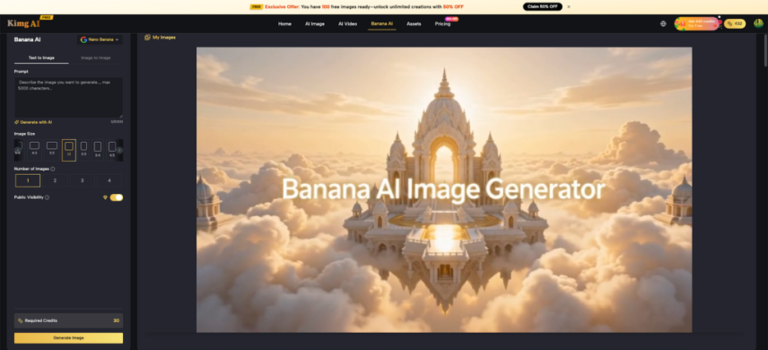
On the surface, Banana AI may look like a straightforward image tool, but on Kimg AI, it offers a more complete workflow for text-to-image creation, image-to-image editing, and reference-based visual control. That broader structure matters, because Banana AI is not limited to a single fixed model or a single type of creative task.
Within that model family, Nano Banana 2 stands out for a reason. It brings together stronger prompt understanding, richer reference support, multi-image output, and practical high-resolution generation up to 4K, making it one of the most balanced choices for creators who care about both control and useful results.
I. Banana AI Is Not Just One Model
1. It works as a model family
Banana AI should not be treated as a single fixed tool. It includes Nano Banana, Nano Banana 2, and Nano Banana Pro, and each version serves a different kind of image task.
2. The differences actually matter
Some users only need fast concept images. Others need stronger editing control, more references, or better consistency across a series. That is where the separation between the three versions becomes important.
3. Nano Banana 2 sits in the sweet spot
Nano Banana 2 feels especially well positioned because it offers more control than the basic model, while staying highly practical for repeat use. It does not depend on flashy claims to feel useful; it feels useful because the workflow itself is better.
II. The Hidden Strength Starts With Prompt Understanding
1. Long prompts are not wasted
The page allows detailed prompts, which makes a real difference for image work. A short idea can create a picture, but a layered prompt can shape tone, framing, style, lighting, object relationships, and editing intent in one pass.
2. Better understanding means fewer repair rounds
One of the biggest hidden costs in image creation is not the first result. It is the time spent fixing details that the model misunderstood. Nano Banana 2 stands out because it handles richer instructions more cleanly.
3. That makes output feel more deliberate
Instead of producing images that only look impressive at first glance, the model is better at staying close to the actual request. That matters for product scenes, branding work, character design, and any image that needs to match a specific idea rather than just look attractive.
III. Reference Images Change Everything
1. Reference support is one of the real advantages
Many people focus only on text prompts, but reference images often do more to improve consistency than extra wording. When a tool can work from multiple references, it becomes much easier to hold onto style, face shape, clothing logic, material texture, or overall composition.
2. The upload limits reveal the positioning
On this page, Nano Banana can upload up to 4 reference images. Nano Banana Pro can upload up to 8 reference images. Nano Banana 2 can upload up to 13 reference images, which gives it a much wider working range for structured visual direction.
3. More references mean more reliable continuity
That is especially useful for creators building a repeating visual identity. A single poster can be made with almost any decent model, but a series of images that need to feel connected requires stronger reference control. This is one of the clearest reasons Nano Banana 2 feels more valuable than it first appears.
IV. Editing Is Where Its Practical Value Becomes Clear
1. Starting from an existing image often works better
Pure generation is useful, but many real tasks begin with a draft, a product shot, a portrait, or an old campaign visual. Image-to-image editing gives far more control because the base structure already exists.
2. It is better for controlled changes
Sometimes the goal is not to invent something entirely new. The job may be to change a background, adjust styling, shift mood, refine composition, or improve visual polish without losing the original subject. That kind of editing is often far more useful than raw generation.
3. Refinement matters more than novelty
A model becomes more valuable when it helps improve good material instead of replacing everything from scratch. This is why the Banana AI workflow feels practical: it supports a process of adjustment, correction, and visual tightening, not just one-click image output.
V. The Workflow Helps Real Projects Move Faster
1. Batch generation improves decision-making
The ability to generate multiple variations in one request is more important than it sounds. It gives teams options right away, which makes it easier to compare framing, mood, styling, and composition without resetting the whole process each time.
2. Resolution choices are grounded in actual use
The page supports output quality up to 4K. There is no 16K option, which is actually a good reminder that useful image quality matters more than inflated numbers. For most design, content, and campaign needs, 4K is already strong enough to support serious production work.
3. It reduces tool-switching
A lot of image work breaks down when one tool is needed for prompting, another for composition, and another for refinement. Banana AI is appealing because generation, editing, reference-based control, and output selection live in one flow. That saves energy as much as time.
VI. Why Nano Banana 2 Feels Like the Best-Value Option
1. It avoids the usual trade-off
Basic models are often easy to use but too limited for complex work. High-end models can be powerful but feel excessive for everyday tasks. Nano Banana 2 lands in a much more useful middle ground.
2. It supports serious control without overcomplicating the page
Users can move between text-to-image and image-to-image, work with multiple references, compare outputs, and aim for clear final quality settings. That makes the model feel capable without becoming awkward to use.
3. It gives stronger results per attempt
Value in image generation is not only about output quality. It is also about how often a model produces something close to usable on the first or second round. Nano Banana 2 performs well here because it combines prompt understanding, stronger reference support, and a workflow that encourages controlled iteration.
VII. Who Benefits Most From It
1. Brand teams
Teams that need visual consistency across banners, social creatives, product scenes, and campaign variants can benefit from the larger reference capacity and cleaner direction control.
2. Content creators
Creators working on thumbnails, character visuals, story scenes, or editorial-style graphics often need a model that can keep a recognisable look across several outputs. That is where Nano Banana 2 becomes especially handy.
3. E-commerce and visual marketing users
Product background changes, style adjustments, and polished promotional images often need editing more than pure invention. Banana AI Image Maker fits well in that kind of work because it supports both creation and controlled transformation inside the same page.
Conclusion
The real strength of Nano Banana 2 lies in how naturally it fits into serious image work. It gives users more control without making the process heavier, and it improves consistency without taking away speed. That balance is difficult to find, which is exactly why it feels more valuable than many louder image models.
In the end, the best-value model is rarely the one that sounds the most advanced. It is the one that helps people create better images with fewer compromises, fewer retries, and more confidence in the result. By that standard, Nano Banana 2 has already become one of the smartest choices available on Kimg AI.

0 Comments