


Understanding IRA Diversification and Its Importance
Diversifying an IRA means strategically spreading our investments across various asset classes, industries, and geographies to minimize risk and enhance long-term returns. It’s akin to not putting all our eggs in one basket. By doing so, we aim to reduce the impact of poor performance from any single investment or market sector on our overall portfolio.
The importance of diversification cannot be overstated, especially when planning for retirement. Markets are inherently volatile, and economic cycles can lead to significant swings in asset values. A well-diversified IRA helps us navigate these uncertainties. When one asset class underperforms, another might be thriving, helping to smooth out returns and protect our capital. For instance, during the 2008–2009 bear market, a portfolio diversified with 70% stocks, 25% bonds, and 5% short-term investments experienced significantly fewer losses than an all-stock portfolio, yet it still captured much of the subsequent market recovery. This demonstrates diversification’s power to limit downside risk while retaining upside potential.
Our goal is not just to avoid losses, but to improve returns for the level of risk we are comfortable taking. By investing in assets whose returns historically haven’t moved in perfect lockstep, we can create a more stable and predictable growth trajectory for our retirement savings.
The Role of Asset Allocation in Retirement Planning
Asset allocation is the cornerstone of diversification, determining how our investment capital is divided among different asset classes like stocks, bonds, and cash equivalents. This decision is deeply personal, driven by our individual time horizon, risk tolerance, and specific financial goals.
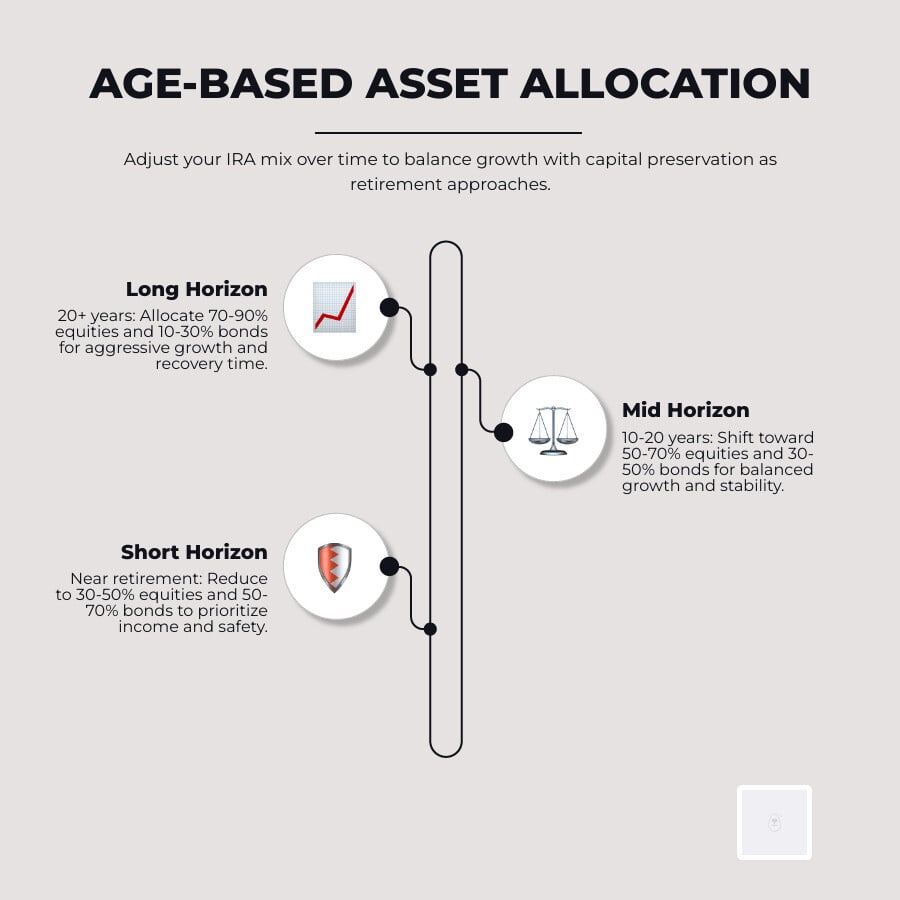
Time Horizon: This refers to the number of years we have until we need to start withdrawing funds from our IRA. A longer time horizon (e.g., 20+ years until retirement) typically allows for a higher allocation to growth-oriented assets like stocks, as there’s more time to recover from market downturns. Conversely, a shorter time horizon (e.g., nearing or in retirement) usually calls for a more conservative allocation, shifting towards income-generating and capital-preserving assets like bonds.
Risk Tolerance: This is our psychological comfort level with potential investment losses. Some investors are comfortable with significant market fluctuations in pursuit of higher returns, while others prioritize capital preservation and stability. Understanding our own risk tolerance is crucial; an asset allocation that causes us undue stress is unlikely to be maintained, potentially leading to emotional and costly decisions during market volatility.
Age-Based Allocation: A common guideline for asset allocation suggests gradually reducing equity exposure as we age. For example, a young investor with many years until retirement might allocate 70-90% to stocks and 10-30% to bonds, aiming for aggressive growth. A retired investor, however, might allocate 30-50% to stocks and 50-70% to bonds, prioritizing income and capital preservation. While these are general guidelines, they highlight the dynamic nature of asset allocation. Hypothetical portfolios from 1926–2024 illustrate this: a 100% stock allocation yielded an average annual return of 10.20%, while a 60% stocks/40% bonds allocation returned 8.60%. The lower stock allocation provides greater stability, albeit with slightly lower historical returns.
Portfolio Rebalancing: Asset allocation isn’t a one-time decision; it requires regular maintenance through rebalancing. Over time, market movements can cause our portfolio’s asset mix to drift from its original target. For instance, if stocks have a strong bull run, their proportion in our portfolio might grow significantly, inadvertently increasing our overall risk beyond our comfort level. Without rebalancing, a hypothetical portfolio from 2000 to 2020 saw its stock allocation grow substantially, increasing overall portfolio risk beyond the investor’s original target.
Rebalancing involves periodically adjusting our portfolio back to its target allocation. This typically means selling assets that have performed well and now represent a larger portion of the portfolio, and using those proceeds to buy assets that have underperformed and now represent a smaller portion. We should aim to rebalance at least once a year, or whenever our financial circumstances change significantly. This disciplined approach helps us maintain our desired risk level and ensures we are consistently buying low and selling high.
Target-Date Funds: For investors who prefer a hands-off approach to asset allocation and rebalancing, target-date funds offer a convenient solution. These funds automatically adjust their asset mix over time, becoming more conservative as the target retirement date approaches. They provide instant diversification and professional management, simplifying the investment process.
Traditional IRA vs. Roth IRA Tax Treatments
Understanding the tax implications of different IRA types is fundamental to optimizing our diversification strategy. While both Traditional and Roth IRAs offer tax advantages for retirement savings, they differ significantly in when those tax benefits are realized.
Traditional IRA:
- Contributions: Contributions to a Traditional IRA are often tax-deductible in the year they are made, meaning they can reduce our current taxable income.
- Growth: Investments within a Traditional IRA grow on a tax-deferred basis. We don’t pay taxes on dividends, interest, or capital gains each year.
- Withdrawals: When we retire and begin taking distributions, these withdrawals are taxed as ordinary income. The idea is that we may be in a lower tax bracket in retirement.
- Required Minimum Distributions (RMDs): We are generally required to start taking distributions from a Traditional IRA once we reach a certain age (currently 73, as of July 2026).
Roth IRA:
- Contributions: Contributions to a Roth IRA are made with after-tax dollars, meaning they are not tax-deductible in the year they are made.
- Growth: Like Traditional IRAs, investments within a Roth IRA grow tax-deferred.
- Withdrawals: The significant advantage of a Roth IRA is that qualified withdrawals in retirement are completely tax-free. This includes both our original contributions and all the earnings. This tax-free growth makes Roth IRAs particularly attractive for younger investors or those who anticipate being in a higher tax bracket in retirement.
- RMDs: Roth IRAs do not have RMDs for the original owner, providing greater flexibility in managing our retirement income and estate planning.
Compounding Interest: Both IRA types harness the power of compounding interest, where earnings generate their own earnings over time. The tax advantages—whether upfront deductions or tax-free withdrawals—supercharge this compounding effect, allowing our wealth to grow more efficiently than in a taxable brokerage account. The choice between a Traditional and Roth IRA often depends on our current income, anticipated future tax bracket, and eligibility requirements.
The Three Pillars of a Diversified IRA Portfolio
To truly diversify our IRA and build a resilient retirement portfolio, we need to consider a range of asset classes that typically react differently to various market cycles and economic conditions. We often think of diversification primarily in terms of stocks and bonds, but a robust strategy incorporates a third pillar: physical commodities. This approach helps us hedge against inflation, protect purchasing power, and reduce overall portfolio volatility.
Equities and Fixed Income as Growth and Stability Engines
Equities (Stocks): Stocks represent ownership in companies and are generally considered the primary engine for long-term growth in a retirement portfolio. They offer the potential for significant capital appreciation and, in many cases, regular income through dividends.
- Dividend Stocks: These are shares of companies that distribute a portion of their profits to shareholders, typically quarterly. Dividend stocks can provide a steady stream of income, which can be particularly appealing for retirees or those seeking to reinvest for accelerated compounding. They often represent more established companies and can offer a degree of stability.
- Growth Funds: These mutual funds or ETFs invest in companies with high potential for capital appreciation, often reinvesting earnings to fuel further expansion. Growth stocks tend to be more volatile but can offer substantial returns during bull markets. Examples include technology companies or emerging industries.
- S&P 500 Funds: These are mutual funds or ETFs that track the performance of the S&P 500 index, providing broad market exposure to 500 large U.S. companies. They offer instant diversification across various sectors and market capitalizations, making them a popular choice for core equity holdings.
- Individual Stocks: While offering the potential for concentrated gains, individual stock picking requires significant research and carries higher risk. For most IRA investors, broad market funds are a more prudent approach to equity exposure.
Fixed Income (Bonds): Bonds represent loans made to governments or corporations and are generally considered the stability component of a diversified portfolio. They typically offer lower returns than stocks but also lower volatility, providing a cushion during stock market downturns.
- High-Yield Bonds: Also known as “junk bonds,” these are debt securities issued by companies with lower credit ratings. To compensate investors for the increased risk of default, they offer higher interest rates (yields). While they can provide attractive income, high-yield bonds can decline significantly during economic downturns, behaving more like stocks than traditional investment-grade bonds.
- Investment-Grade Bonds: These are issued by financially strong entities and carry lower default risk, offering more predictable income and capital preservation.
- Bond Funds: ETFs and mutual funds that invest in a diversified portfolio of bonds are an efficient way to gain fixed-income exposure without having to purchase individual bonds. They can be diversified by maturity, credit quality, and duration.
- Individual Bonds: Similar to individual stocks, investing in individual bonds requires expertise and can be less diversified than bond funds.
The blend of equities and fixed income should align with our risk tolerance and time horizon. Younger investors might tolerate a higher allocation to growth-oriented equities, while those nearing retirement might favor a higher proportion of stable fixed-income investments.
Physical Gold and Silver as Portfolio Insurance
While equities drive growth and bonds provide stability, the third pillar of a truly diversified IRA portfolio, especially in uncertain economic environments, is physical commodities, particularly precious metals like gold and silver. These tangible assets serve as a unique form of “portfolio insurance,” offering distinct benefits that traditional paper assets often cannot.
- Tangible Assets: Unlike stocks or bonds, which are paper promises, physical gold and silver are tangible assets with intrinsic value. They have been recognized as stores of wealth for millennia, transcending national currencies and political systems.
- Wealth Preservation: Precious metals have historically demonstrated an ability to preserve purchasing power during periods of inflation and currency devaluation. When the value of fiat currency declines, the value of gold and silver often rises, acting as a hedge against economic uncertainty.
- Central Bank Buying: A significant indicator of gold’s role as a reserve asset is the consistent buying by central banks globally. For over a decade, central banks have been net buyers of gold, diversifying their reserves away from single currencies and signaling gold’s importance as a strategic asset for national wealth preservation. This institutional confidence underscores gold’s enduring value.
- Systemic Risk Mitigation: In times of severe financial crisis or systemic risk, when traditional markets experience widespread panic and correlation among assets tends to increase, gold often performs as a safe haven. Its non-correlated nature can provide a crucial buffer, helping to stabilize a portfolio when other assets are plummeting. For those seeking to explore the benefits of incorporating these assets into their retirement strategy, delving into Trusted Precious Metals IRA diversification can provide valuable insights into how to integrate them effectively.
By including physical gold and silver, we add a layer of protection that can help our IRA weather economic storms, preserve our purchasing power, and contribute to overall portfolio resilience.
Why Physical Precious Metals Outperform Paper Assets
When considering precious metals for IRA diversification, it’s crucial to distinguish between direct ownership of physical metals and investments in “paper gold” assets like gold ETFs or mining stocks. While these paper assets offer convenience, they carry inherent risks that physical metals do not, particularly concerning counterparty risk and systemic vulnerability.
The Hidden Risks of Gold ETFs and Mining Stocks
Gold ETFs (Exchange-Traded Funds): Gold ETFs track the price of gold, but owning shares in an ETF does not mean we own physical gold bullion directly. Instead, we own shares in a fund that holds gold on our behalf. This introduces several layers of counterparty risk:
- Fund Management Fees: ETFs charge annual management fees, which can erode returns over time.
- Market Liquidation: In a severe market downturn, if many investors try to redeem their ETF shares simultaneously, the fund might face liquidity issues or be forced to sell its underlying gold holdings at unfavorable prices.
- Tracking Errors: The ETF’s price may not perfectly track the spot price of gold due to fees, expenses, or operational inefficiencies.
- Custodial Risk: We are reliant on the fund’s custodian to hold the physical gold securely and honestly. While reputable, this is still a third-party risk.
Mining Stocks: Investing in gold mining stocks means owning shares in companies that extract gold from the earth. While these stocks can offer leverage to gold price movements, they come with a different set of risks:
- Operational Risks: Mining operations are subject to geological challenges, labor disputes, environmental regulations, political instability in mining regions, and accidents, all of which can impact profitability and stock performance.
- Corporate Debt: Many mining companies carry significant debt, which can become problematic during periods of lower gold prices or economic stress.
- Management Quality: The success of a mining company heavily depends on the quality of its management team and their ability to execute operations efficiently.
- Not Pure Gold Exposure: The stock price of a mining company is influenced by many factors beyond just the price of gold, including overall equity market sentiment, company-specific news, and general economic conditions.
While gold ETFs and mining stocks offer exposure to gold’s price movements, they do not provide the same level of direct, unencumbered ownership and protection against systemic risk that physical gold does. They are still paper assets, susceptible to the same vulnerabilities as other financial instruments in a crisis.
Direct Ownership via a Precious Metals IRA
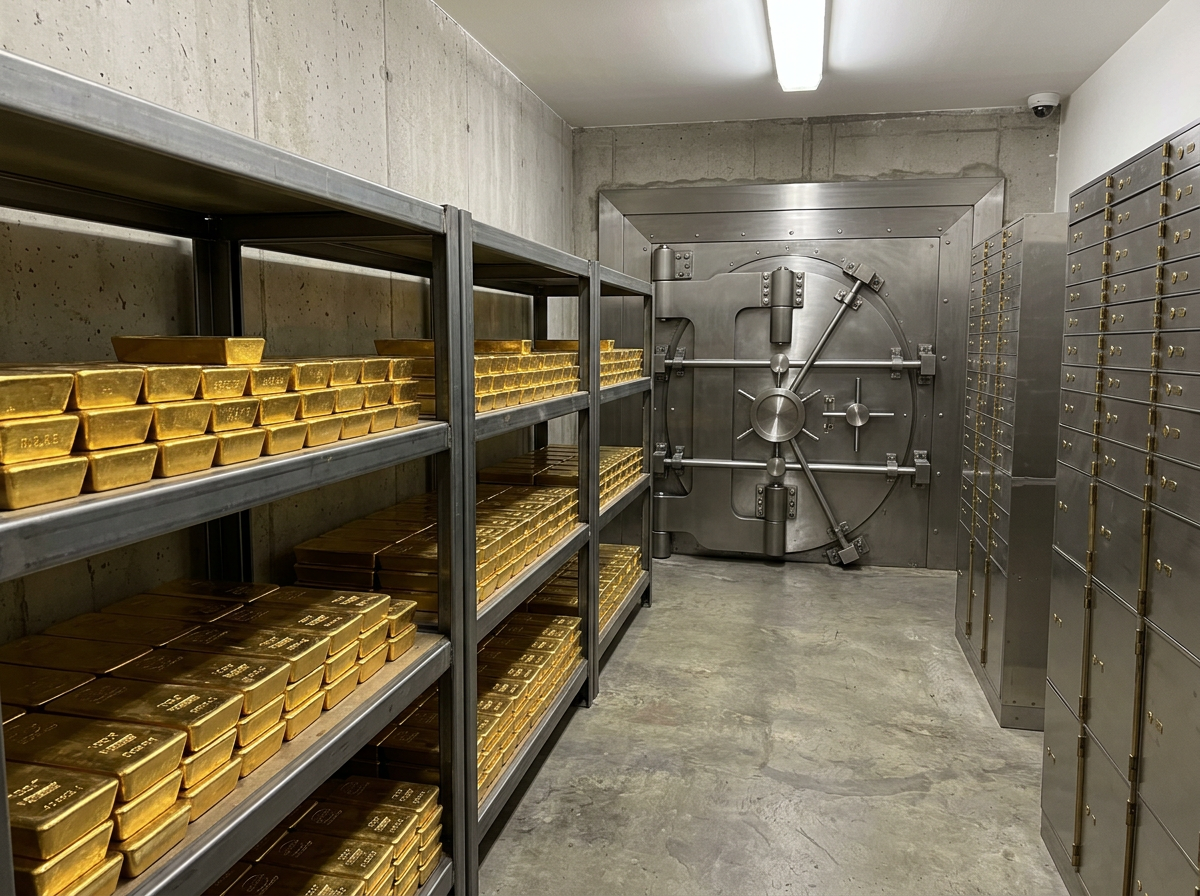
Direct ownership of physical precious metals through a Self-Directed IRA (SDIRA) eliminates many of the counterparty risks associated with paper assets. This approach allows us to hold IRS-approved physical gold, silver, platinum, or palladium bullion directly in our retirement account, stored in a secure, approved depository.
- Physical Custody and Tangible Control: With a Precious Metals IRA, we have direct ownership of specific, allocated physical bullion. While we don’t physically hold the metals ourselves (IRS rules prohibit home storage), we have legal title to them, and they are held in our name at an independent, third-party depository. This provides a sense of tangible control and security that paper assets cannot match.
- Wealth Security: In a scenario where financial institutions face severe distress or a currency experiences hyperinflation, physical metals held outside the traditional banking system can offer unparalleled wealth security. They are not subject to bank solvency concerns, government confiscation (under normal circumstances, and with proper legal structures), or the whims of corporate balance sheets.
- Inflation Protection: Physical gold and silver have historically served as reliable hedges against inflation. As the cost of living rises and the purchasing power of fiat currencies erodes, precious metals tend to maintain or increase their value, protecting our retirement savings from the silent tax of inflation.
- Asset Preservation: The goal of a Precious Metals IRA is often less about speculative growth and more about long-term asset preservation. It’s about ensuring that a portion of our retirement wealth is held in a form that has historically endured economic and political upheavals, providing a stable foundation for our financial future.
This direct ownership model offers a unique form of diversification, providing a tangible hedge against the uncertainties inherent in the modern financial system.
How to Establish a Precious Metals IRA
Establishing a Precious Metals IRA, also known as a Gold IRA or Silver IRA, allows us to hold physical gold, silver, platinum, and palladium within a tax-advantaged retirement account. This process involves working with specialized custodians and adhering to specific IRS regulations.

Step 1: Choosing a Self-Directed IRA Custodian
The first and most critical step is to select a qualified Self-Directed IRA (SDIRA) custodian. Unlike traditional IRA custodians that typically only offer conventional investments like stocks, bonds, and mutual funds, an SDIRA custodian specializes in facilitating alternative assets.
- Expertise in Alternative Assets: The custodian must be experienced in handling physical precious metals and other non-traditional investments. They will guide us through the specific rules and regulations governing these assets within an IRA.
- Administrative Compliance: SDIRA custodians are responsible for ensuring our account remains compliant with all IRS regulations, particularly those concerning prohibited transactions and eligible assets. Their administrative expertise is crucial for avoiding costly penalties.
- IRS Regulations: We must choose a custodian that is approved by the IRS to hold IRA assets. They will manage the paperwork, facilitate the purchase and storage of our metals, and handle all reporting requirements.
- Account Setup: The custodian will help us open a new Self-Directed IRA account (Traditional, Roth, SEP, or SIMPLE, depending on our eligibility and preferences) specifically designed to hold physical precious metals.
Step 2: Funding Your Account via Rollover or Transfer
Once our SDIRA is established, the next step is to fund it. This is typically done by moving funds from an existing retirement account.
- Direct Rollover: This is the most common and recommended method. We can instruct the administrator of an existing 401(k), 403(b), TSP, or even another IRA to directly transfer funds to our new Precious Metals SDIRA custodian. The funds go directly from one custodian to another, bypassing us entirely. This method is tax-free and penalty-free, with no limit on the amount rolled over.
- Trustee-to-Trustee Transfer: Similar to a direct rollover, this involves moving funds from an existing IRA directly to the new SDIRA custodian. It’s also tax-free and penalty-free.
- 60-Day Rollover (Indirect Rollover): In this method, the funds are paid directly to us, and we then have 60 days to deposit them into the new SDIRA. While permissible, this method carries risks. If we miss the 60-day deadline, the distribution becomes taxable and may incur a 10% early withdrawal penalty if we are under 59½. There are also limitations on how often we can perform a 60-day rollover. For these reasons, direct rollovers and trustee-to-trustee transfers are generally preferred for their simplicity and safety.
- New Contributions: We can also fund a Precious Metals IRA with new annual contributions, subject to the IRS contribution limits for the current year (e.g., for July 2026, the standard limit is $7,500, or $8,600 for those age 50 and older).
Step 3: Selecting IRS-Approved Physical Metals
With our SDIRA funded, we can now select the specific precious metals to include in our portfolio. It’s crucial to understand and adhere to IRS purity standards.
- Purity Standards: The IRS mandates specific fineness requirements for precious metals held in an IRA. For gold, it must be at least 99.5% pure (.995 fineness), with the exception of American Gold Eagle coins, which are 91.67% pure but IRA-eligible. Silver must be at least 99.9% pure (.999 fineness). Platinum and palladium must also meet specific purity thresholds.
- Eligible Products: Common IRA-eligible products include American Gold and Silver Eagles, Canadian Maple Leafs, Austrian Philharmonics, and various government-minted coins and privately minted bars/rounds that meet the purity requirements. Certain collectibles, such as rare coins, are generally not permitted.
- Approved Depositories: Once purchased, our physical metals must be stored at an IRS-approved, third-party depository. We cannot store IRA precious metals at home or in a safe deposit box at a local bank. The custodian will facilitate the purchase and arrange for secure storage on our behalf. These depositories offer high-security vaults, insurance, and audit trails to ensure the safety and integrity of our assets.
- Secure Storage: The metals are typically stored in segregated accounts, meaning our specific bullion is kept separate from other investors’ holdings, identifiable by serial numbers or other unique markings.
By following these steps, we can effectively diversify our IRA with physical precious metals, adding a layer of tangible security and inflation protection to our retirement savings.
Frequently Asked Questions About a Precious Metals IRA
When considering a Precious Metals IRA, it’s natural to have questions about the specifics of eligible metals, storage, and tax implications. Here, we address some of the most common inquiries.
What physical metals are eligible for a Precious Metals IRA?
The IRS has strict criteria for the types of precious metals that can be held in an IRA. The primary requirement revolves around purity (fineness).
- Gold: Must be at least 99.5% pure (.995 fineness). Examples include American Gold Buffalo coins, Canadian Gold Maple Leaf coins, Austrian Philharmonic gold coins, and various gold bars and rounds from approved refiners. The notable exception is the American Gold Eagle coin, which is 91.67% pure but specifically approved by the IRS due to its government mintage.
- Silver: Must be at least 99.9% pure (.999 fineness). Eligible products include American Silver Eagle coins, Canadian Silver Maple Leaf coins, and silver bars and rounds from approved refiners.
- Platinum: Must be at least 99.95% pure (.9995 fineness). Examples include American Platinum Eagle coins and platinum bars/rounds from approved refiners.
- Palladium: Must be at least 99.95% pure (.9995 fineness). Eligible products include palladium bars/rounds from approved refiners.
“Collectibles” such as rare or numismatic coins, even if made of precious metals, are generally not permitted in an IRA. The intent is for the investment to be in the metal’s intrinsic value, not its collectible premium.
How do storage and security work for physical precious metals?
Physical precious metals held within an IRA cannot be stored at home or in a personal safe deposit box. This is a critical IRS rule designed to prevent self-dealing and ensure proper oversight. Instead, the metals must be stored in an IRS-approved depository.
- Approved Depositories: These are highly secure, third-party facilities that specialize in storing valuable assets. They are typically independent of the IRA custodian, providing an additional layer of security and oversight. Examples include Delaware Depository, Brinks, and Malca-Amit.
- Segregated Storage: Most reputable depositories offer “segregated storage,” meaning our specific bullion (identified by serial number or other unique markings) is kept separate from other investors’ holdings. This ensures that when we eventually take a distribution, we receive the exact metals we purchased. Alternatively, “non-segregated” or “commingled” storage means our metals are mixed with others of the same type and fineness.
- Custodial Oversight: Our IRA custodian facilitates the purchase of the metals and arranges for their transfer to the chosen depository. They maintain records of our holdings and act as the administrative link between us and the depository.
- Insurance: Approved depositories carry comprehensive insurance policies to protect against theft, damage, or loss, providing peace of mind regarding the safety of our assets.
- Audits: These facilities are subject to regular audits to ensure compliance and the accurate accounting of all stored assets.
Are there tax penalties for rolling over an existing IRA into physical metals?
One of the most appealing aspects of funding a Precious Metals IRA is the ability to transfer funds from existing retirement accounts without incurring immediate taxes or penalties, provided the process is handled correctly.
- Direct Rollovers and Trustee-to-Trustee Transfers: As discussed earlier, these methods involve the funds moving directly from one qualified retirement account to another. Because the funds never pass through our hands, the IRS considers this a non-taxable event. There are no taxes withheld, and no penalties are assessed, regardless of our age. This is the recommended approach for a tax-free and penalty-free diversification into physical precious metals.
- Penalty-Free Diversification: The ability to move funds from a Traditional 401(k), 403(b), TSP, or existing Traditional/Roth IRA into a Precious Metals IRA allows us to diversify our retirement portfolio with tangible assets while maintaining the tax-advantaged status of our retirement savings. This means our physical gold, silver, platinum, or palladium can grow tax-deferred (in a Traditional IRA) or tax-free (in a Roth IRA), just like traditional investments.
- 60-Day Rollover Warning: We must reiterate the caution against the “60-day rollover” (where funds are distributed to us directly). If not redeposited into a new IRA within 60 days, the entire amount becomes taxable, and a 10% early withdrawal penalty may apply if we are under age 59½. Stick to direct transfers for peace of mind and compliance.
By understanding these FAQs, we can approach the process of diversifying our IRA with physical precious metals with greater confidence and clarity.
Conclusion
Building a secure and prosperous retirement requires a thoughtful and dynamic approach to investment. While traditional stocks and bonds form the bedrock of many retirement portfolios, true resilience in an ever-changing economic landscape demands broader diversification. We’ve explored how understanding our risk tolerance and time horizon informs our asset allocation, and the critical differences in tax treatment between Traditional and Roth IRAs.
Beyond conventional equities and fixed income, we’ve seen how physical precious metals—gold, silver, platinum, and palladium—serve as a vital third pillar for IRA diversification. These tangible assets offer a unique form of portfolio insurance, providing a hedge against inflation, currency devaluation, and systemic financial risks that paper assets cannot fully address. By choosing direct ownership of physical bullion through a Self-Directed IRA, we gain tangible control and minimize counterparty risks inherent in paper gold investments like ETFs or mining stocks.
The process of establishing a Precious Metals IRA, from selecting a qualified custodian to funding via tax-free rollovers and choosing IRS-approved metals, is straightforward when guided by expertise. This strategic move allows us to fortify our retirement savings, ensuring that a portion of our wealth is held in assets with a proven track record of preserving value across millennia.
Diversifying our IRA with physical precious metals is about enhancing portfolio resilience, securing our long-term purchasing power, and achieving greater financial preparedness for whatever the future may hold. It’s a proactive step towards a more robust and worry-free retirement.

0 Comments