

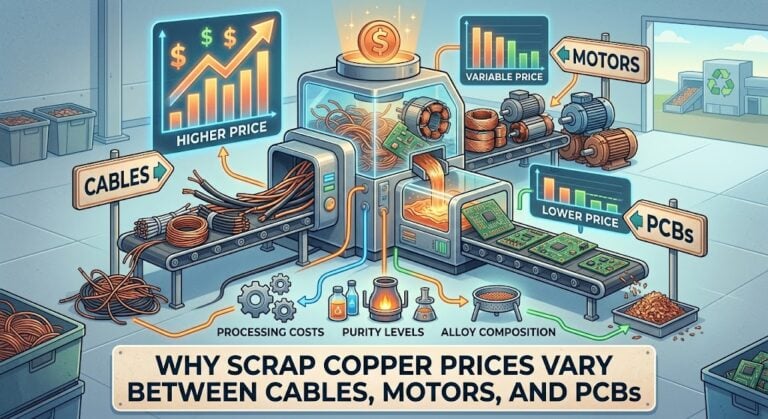
Two loads can contain copper and still receive very different offers from a recycler. A clean bundle of stripped copper wire, a pallet of electric motors, and a box of printed circuit boards may all look valuable, but their market value depends on much more than total weight. Copper concentration, processing costs, contamination, recoverable precious metals, and even the consistency of the batch all influence the final price.
Understanding these differences helps businesses and individuals sort material correctly, compare offers more intelligently, and avoid leaving money on the table. It also explains why the headline copper price reported by commodity markets is not the same as the amount paid for copper-bearing scrap.
The Market Copper Price Is Only a Starting Point
Commodity quotations generally refer to standardized, refined copper—not mixed scrap waiting to be dismantled, separated, sampled, and processed. A recycler must estimate how much saleable metal can be recovered from a load and subtract the costs and risks involved in getting it to that stage.
A simplified valuation can be viewed as:
Estimated recoverable metal value − processing costs − impurities − market risk = scrap purchase price
The calculation may also include other recoverable metals. This is especially important for printed circuit boards, where gold, silver, palladium, and other metals can contribute substantially to the value. For that reason, evaluating every item only according to its visible copper content can produce misleading results.
Why Copper Cable Prices Depend on Preparation
Cables are often considered straightforward copper scrap, yet their recovery rates vary widely. Bright, clean, stripped copper wire contains a high percentage of readily recoverable metal. Insulated household wire, communication cable, armored cable, and mixed industrial cable contain different proportions of copper, plastic, steel, aluminum, and other materials.
The main cable pricing factors include:
- Copper yield: A cable containing a high proportion of copper per kilogram generally commands a better price than heavily insulated cable.
- Conductor material: Some cables that appear similar may contain aluminum or copper-clad aluminum rather than solid copper.
- Insulation and armor: Thick plastic, plugs, steel reinforcement, and moisture increase gross weight without adding equivalent metal value.
- Sorting quality: A uniform batch is easier to assess and process than a container mixing several cable grades.
- Processing requirements: Granulation, stripping, and material separation require labor, machinery, energy, and responsible handling of residues.
Manual stripping is not automatically the best financial decision. For thick, high-grade cable, it may improve the price enough to justify the work. For thin wire or complex harnesses, however, the time and labor required may exceed the increase in value. Before processing a large batch, ask a specialist to compare the price for intact cable with the expected return after preparation.
Why Electric Motors Are Valued Differently
Electric motors contain copper windings, but copper is only one part of their total weight. Steel housings, iron laminations, shafts, bearings, insulation, and sometimes aluminum windings must also be considered. Consequently, a one-ton load of motors should not be compared directly with a one-ton load of copper cable.
Motor values vary according to size, design, copper-to-steel ratio, winding material, and dismantling difficulty. Small motors can have high labor costs relative to the amount of copper recovered. Large industrial motors may contain more valuable windings, but they can require lifting equipment and additional processing. Transformers and sealed units may also need separate handling because of oil, fluids, or other regulated components.
Owners sometimes dismantle motors themselves in an attempt to capture the copper value. This can make sense when safe equipment, skilled labor, and sufficient volume are available. Otherwise, selling complete units may be more efficient. A reputable buyer can explain whether intact motors, separated windings, or sorted components provide the best practical return.
Why PCB Pricing Requires More Than a Copper Estimate
Printed circuit boards are among the most complex copper-bearing materials. Their value depends not only on copper layers but also on board type, component density, precious metal content, age, application, and refinery recovery performance. A modern consumer board, a server board, an industrial control board, and a low-grade power-supply board should not be placed in the same pricing category.
Connectors, processors, plated contacts, relays, and certain components may contain gold, silver, or palladium in small but economically meaningful quantities. At the same time, fiberglass, resin, ceramics, plastics, and base metals add weight and processing complexity. Visual inspection can help classify boards, but it cannot always reveal their complete composition.
This is why professional sampling, reference data, and laboratory analysis matter when evaluating larger or unfamiliar lots. Metalaxis combines specialist assessment with a database of more than 30,000 analyzed catalytic converters and modern analytical capabilities, reflecting the data-led approach needed for complex recyclable materials. Sellers handling electronic scrap (elektroniikkaromu) can benefit from separating boards by origin and grade before requesting an offer.
Five Steps to Improve the Value of a Scrap Load
- Separate materials at the source. Keep clean copper, insulated cables, motors, transformers, and circuit boards in distinct containers. Better sorting reduces uncertainty and can improve grading.
- Remove obvious non-metallic waste. Packaging, dirt, loose plastic, and unrelated debris add handling costs. Do not remove components if doing so is unsafe or likely to reduce recoverable value.
- Record the material’s origin. Information about the equipment, industry, manufacturer, and approximate age can help a buyer classify unusual boards or components.
- Use clear photographs and accurate weights. Images of the overall batch and representative items can support an initial evaluation, although final inspection or analysis may still be necessary.
- Compare grading methods, not just headline prices. Ask whether the offer is based on gross weight, estimated metal yield, fixed categories, sampling, or laboratory results.
Consistency is particularly valuable for recurring commercial loads. If a manufacturer, dismantler, repair company, or recycling business tracks what each material stream contains, both seller and buyer can make faster and more reliable decisions.
Market Conditions and Refinery Terms Also Matter
Even a correctly sorted batch can change in value over time. Copper prices move with global manufacturing demand, mine supply, inventories, energy costs, currency exchange rates, and economic expectations. Refinery charges and demand for secondary raw materials can also affect purchasing terms.
PCBs add another layer because their value may follow several metal markets simultaneously. Copper could decline while gold or palladium rises, changing the economics of a particular board grade. Buyers therefore need current market information and reliable downstream refinery relationships rather than a single static price list.
When reviewing the price of electrical scrap (sähköromun hinta), sellers should request a clear explanation of how material category, recovery rate, analysis, and current markets shaped the offer. Transparency is often more valuable than an unusually high preliminary quote that changes after delivery.
Choose Accuracy Over Assumptions
The central lesson is simple: copper-bearing items are not interchangeable. Cables are strongly influenced by insulation and conductor yield, motors by their copper-to-steel ratio and dismantling costs, and PCBs by their complete metal composition and grade. Good sorting helps, but accurate classification and analysis are what turn apparent weight into realistic value.
Metalaxis supports businesses and individuals across Finland with secure purchasing, prompt transactions, detailed material evaluation, and recycling routes designed to maximize recovery. If you have a mixed or high-volume load, prepare representative photos, separate the main categories, note the approximate weights, and request an assessment before investing in dismantling. That small step can protect both your margins and the environmental benefits of responsible metal recycling.

0 Comments