

In today’s fast-moving digital world, businesses face many challenges. It’s hard to stand out and reach your customers. Many companies struggle to turn online efforts into real growth. In fact, nearly half of all organizations lack a clear digital marketing strategy. This often leads to wasted time and money.
We believe a strong strategy is your map to success. It helps you cut through the noise. It guides your actions and makes sure every step counts. A well-thought-out plan changes your digital presence from scattered efforts to a powerful growth engine.
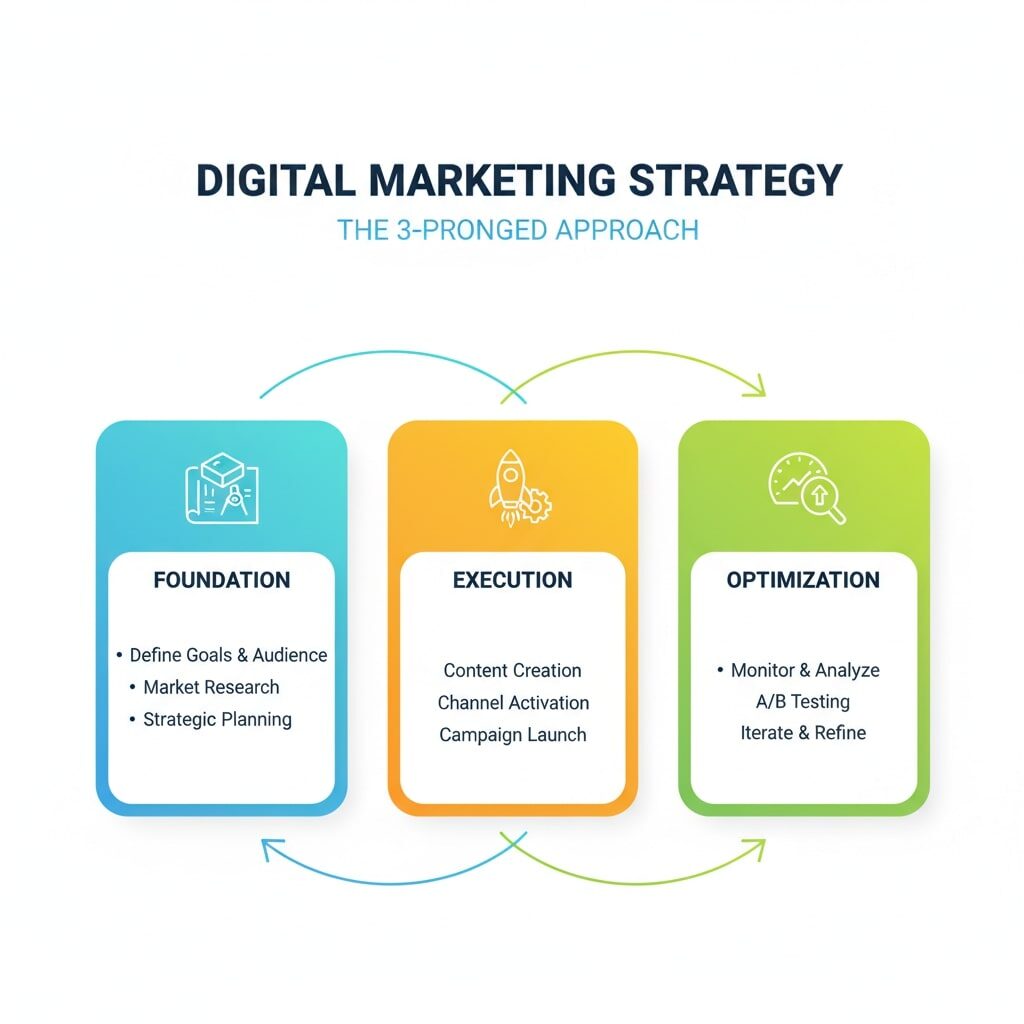
This guide will show you how to build such a plan. We will walk you through a simple, yet powerful, 3-pronged approach. This includes building a solid Foundation, flawless Execution, and smart Optimization. We will also explore how an AI-powered marketing strategy can give you a competitive edge.
Let’s explore how to drive growth in this modern digital age. We will turn your digital marketing into a clear roadmap for success.
A digital marketing strategy is more than just a list of things to do online; it’s a long-term, high-level plan that defines your objectives, identifies your target audience, and provides a comprehensive framework for all your marketing activities across digital channels. It’s the “what” and “why” behind your online efforts, serving as a strategic compass that aligns with your broader business goals. Without this foundational strategy, digital marketing can quickly become a series of disconnected tactics, yielding inconsistent and often disappointing results.
This differs significantly from marketing tactics or campaigns. Tactics are the specific, granular actions you take (e.g., posting on social media, running a specific ad, optimizing a webpage). Campaigns are targeted efforts designed to achieve a specific goal within a defined timeframe, often utilizing several tactics. The strategy provides the overarching direction, ensuring that all campaigns and tactics work in harmony towards a common, well-defined objective. Think of it this way: the strategy is the blueprint for a house, campaigns are the construction phases (foundation, framing, roofing), and tactics are the individual tasks (laying bricks, hammering nails).
The core components of a successful digital marketing strategy include a deep understanding of your business objectives, a thorough market analysis to identify opportunities and threats, and a clear picture of your competitive landscape. These elements collectively inform your strategic choices, allowing you to allocate resources effectively and pursue initiatives that offer the greatest potential for impact.

Defining SMART Goals and Positioning
The first critical step in building your foundational strategy is to define clear, measurable goals. We recommend using the SMART framework:
- Specific: Goals should be precise and unambiguous. Instead of “increase sales,” aim for “increase online sales of product X by 15%.”
- Measurable: You must be able to quantify progress and determine if the goal has been met. This requires setting up proper tracking and analytics.
- Achievable: While ambitious, goals should be realistic and attainable given your resources and market conditions.
- Relevant: Goals must align with your overall business objectives. Increasing social media followers might be a tactic, but if it doesn’t contribute to lead generation or sales, it’s not a relevant strategic goal.
- Time-bound: Every goal needs a deadline. “Increase website traffic by 20% within the next six months” is more effective than an open-ended statement.
Common strategic goals include enhancing brand awareness, generating qualified leads, acquiring new customers, boosting conversion rates, or improving customer retention. Once your goals are set, your positioning comes into play. This involves defining your unique value proposition – what makes your business stand out? This requires both a robust company analysis (understanding your strengths and weaknesses) and a thorough competitor analysis (identifying what others offer and where you can differentiate). Your positioning dictates how you want your target audience to perceive your brand relative to the competition, forming the bedrock of your messaging across all digital channels.
The Core of Your Strategy: Personas and Journey Maps
To truly connect with your audience, you need to understand them intimately. This is where buyer personas and customer journey mapping become indispensable.
Buyer personas are semi-fictional representations of your ideal customers, built on market research and real data about your existing customers. They go beyond basic demographics to include psychographics, motivations, pain points, goals, and online behaviors. For example, a persona for a B2B software company might be “Marketing Manager Melissa,” who is 35, tech-savvy, struggles with data silos, and seeks efficient reporting tools. Developing detailed personas helps you tailor your messaging, content, and channel selection to resonate directly with those you aim to serve.
Customer journey mapping visually illustrates the entire path a customer takes from their first interaction with your brand to becoming a loyal advocate. It outlines every touchpoint, action, emotion, and question a customer might have at each stage. Typically, this journey includes:
- Awareness Stage: The customer realizes they have a problem or need. (e.g., searching for “how to fix slow internet”).
- Consideration Stage: They research potential solutions and evaluate options. (e.g., comparing internet providers, reading reviews).
- Decision Stage: They choose a solution and make a purchase. (e.g., signing up for a specific internet plan).
- Retention/Advocacy Stages: Post-purchase experience, loyalty, and potentially recommending your brand to others.
Mapping this journey allows you to identify critical touchpoints, potential pain points, and opportunities to provide value and guide customers seamlessly towards conversion and beyond. It ensures your digital marketing efforts are not only reaching the right people but also providing the right information at the right time.
Adapting for Scale: From Startups to Enterprises
A one-size-fits-all approach to digital marketing strategy rarely works. The optimal strategy must be adapted to your business size, industry, and specific market conditions.
For startups and small businesses, digital marketing strategy will likely focus on cost-effective tactics to meet organizational goals. This often means prioritizing organic growth channels like Search Engine Optimization (SEO) and content marketing to build authority and attract inbound leads over time. Social media marketing can also be highly effective for community building and direct engagement without massive ad spend. The emphasis is on proving value, building a loyal customer base, and demonstrating a clear return on investment for every dollar spent.
As organizations grow into large corporations, their marketing and advertising budgets typically expand in kind, allowing for a broader and more integrated approach. They can invest in more sophisticated paid advertising campaigns, advanced marketing automation, extensive content creation across multiple formats, and global social media initiatives. The complexity of their operations often requires more robust data analytics and specialized teams for different digital channels. However, the core principles of understanding the audience, defining clear goals, and measuring performance remain paramount. Regardless of size, a successful strategy hinges on leveraging insights. Implementing a data-driven digital strategy is essential for businesses of all scales, enabling them to make informed decisions and adapt their approach as they grow and market dynamics shift. This ensures that resources are always directed toward the most impactful activities, whether you’re a lean startup or a multinational enterprise.
Prong 2: Executing with a Powerful Channel Mix
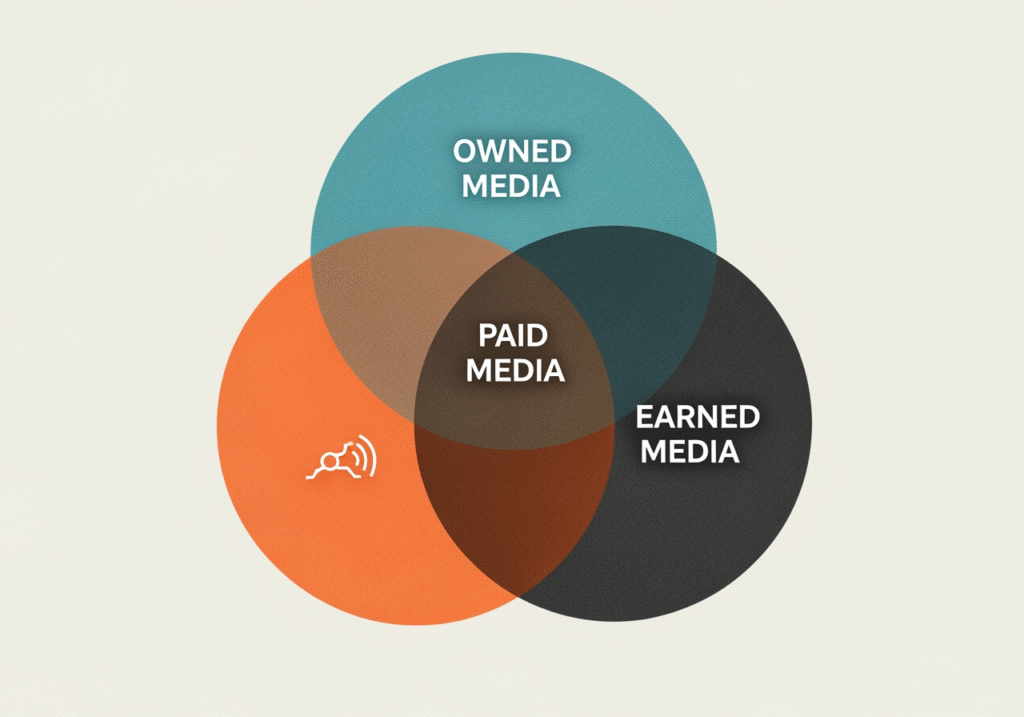
With a solid foundational strategy in place, the next step is execution – bringing your plan to life through a powerful mix of digital channels. This involves understanding and leveraging the “digital marketing trifecta”: owned, paid, and earned media.
- Owned Media: These are the digital properties you control, such as your website, blog, social media profiles, and email lists. They are crucial for building your brand identity, housing your content, and directly communicating with your audience.
- Paid Media: This includes any marketing efforts for which you pay, like search engine ads (PPC), social media ads, display ads, and influencer marketing. Paid media allows for immediate reach, precise targeting, and scalability.
- Earned Media: This refers to exposure gained through promotional efforts other than paid advertising, such as media mentions, social media shares, reviews, and word-of-mouth. It’s the most credible form of media, as it comes from third-party endorsements.
The key to effective execution is not to treat these in isolation but to integrate them seamlessly. An effective digital marketing campaign will reflect a substantially similar message across multiple channels, ensuring a cohesive brand experience and maximizing impact.
Choosing Your Core Channels and Tactics
The digital landscape offers a vast array of channels and tactics. Your choice should always be informed by your buyer personas, customer journey map, and strategic goals. Here are some essential digital marketing channels and tactics to consider:
- Search Engine Optimization (SEO): This involves optimizing your website and content to rank higher in organic search engine results. It’s crucial for capturing high-intent users who are actively searching for solutions. Tactics include keyword research, on-page optimization, technical SEO, and link building.
- Content Marketing: Creating and distributing valuable, relevant, and consistent content (blogs, articles, videos, infographics, guides) to attract and retain a clearly defined audience. Content marketing builds thought leadership and supports other channels like SEO and social media.
- Social Media Marketing (SMM): Utilizing platforms like Facebook, Instagram, LinkedIn, X (formerly Twitter), and TikTok to build brand awareness, engage with your audience, drive traffic, and generate leads. Success hinges on platform-specific content and authentic interaction.
- Email Marketing: A direct, owned channel for nurturing leads, building customer relationships, and driving conversions. Tactics include newsletters, promotional emails, automated sequences (e.g., welcome series, abandoned cart reminders), and segmentation.
- Pay-Per-Click (PPC) Advertising: Running paid ads on search engines (Google Ads) and social media platforms. PPC offers immediate visibility, precise targeting, and measurable results, allowing you to reach specific audiences at critical points in their journey.
- Video Marketing: Creating and distributing video content (tutorials, explainers, testimonials, brand stories) across platforms like YouTube, TikTok, and social media. Video is highly engaging and effective for capturing attention and conveying complex messages.
When choosing, consider where your target audience spends their time online and which channels best serve your specific objectives. For instance, if your goal is to reach customers with high search intent, prioritizing SEO and PPC is often most effective. Where search intent isn’t as high, social media, PR, and display advertising can play a more significant role in building awareness and demand.
Allocating Your Budget for Maximum Impact
Budget allocation is a critical component of execution. It dictates which channels receive resources and how aggressively you can pursue your strategies. Effective budget allocation ensures that your investment yields the highest possible return.
Several models can guide your budgeting decisions, from a simple percentage of revenue to more complex objective-and-task approaches. However, a highly effective method involves allocating your budget based on your customer journey stages and the specific goals you have for each. For instance, you might allocate more to awareness-driving channels (like social media ads or content marketing) if your brand is new, or more to conversion-focused channels (like PPC or email marketing) if your primary goal is immediate sales.
It’s also crucial to consider the cost-effectiveness of different tactics. For startups and small businesses, SEO, content marketing, and strategic social media engagement often offer a lower barrier to entry and a higher long-term ROI compared to continuous, high-spend paid campaigns. As organizations grow, their budgets typically expand, allowing for more diversified and larger-scale investments across all media types. Regardless of your budget size, maintaining a conversion-focused digital strategy ensures that every dollar spent is aimed at moving customers through the funnel, maximizing efficiency and driving tangible business outcomes. Continuous testing and optimization of your budget across channels are vital, allowing you to shift resources to the best-performing areas and adapt to changing market conditions.
Prong 3: Optimizing for Growth with Data and AI
The final prong of our approach is continuous optimization, driven by data and increasingly influenced by artificial intelligence. Digital marketing is not a “set it and forget it” endeavor; it’s an iterative process that requires constant monitoring, analysis, and adaptation. This feedback loop ensures agility, allowing you to refine your strategies, improve performance, and stay ahead in a dynamic digital landscape.

Measuring What Matters: Key Performance Indicators (KPIs) and ROI
To effectively optimize, you must measure the right things. Key Performance Indicators (KPIs) are quantifiable metrics that reflect how well you’re achieving your business objectives. The KPIs you track will directly relate to your SMART goals.
Common digital marketing KPIs include:
- Website Traffic: Total visits, unique visitors, traffic sources.
- Engagement Metrics: Time on page, bounce rate, pages per session.
- Lead Generation: Number of leads, cost per lead (CPL), lead quality.
- Conversion Rate: Percentage of visitors who complete a desired action (e.g., purchase, sign-up).
- Click-Through Rate (CTR): Percentage of people who click on an ad or link.
- Customer Acquisition Cost (CAC): The cost of acquiring a new customer.
- Customer Lifetime Value (CLV): The total revenue a customer is expected to generate over their relationship with your business.
- Return on Investment (ROI): The ultimate measure of success, calculating the profit or loss generated relative to the marketing investment.
Calculating ROI is essential for justifying your marketing spend and demonstrating value. It involves comparing the revenue generated from your digital marketing efforts against the costs incurred. Marketing analytics tools (like Google Analytics, CRM systems, and social media insights) are indispensable for collecting, analyzing, and visualizing this data, providing the insights needed to make informed optimization decisions.
The Influence of AI on Your Digital Marketing Strategy
Artificial Intelligence (AI) has rapidly become a transformative force in digital marketing, fundamentally changing how strategies are created, executed, and optimized. AI tools, particularly generative AI, are proving to be exciting additions to marketers’ toolkits.
AI’s influence spans several critical areas:
- Personalization at Scale: AI algorithms can analyze vast amounts of customer data to deliver highly personalized content, product recommendations, and ad experiences, far beyond what manual segmentation could achieve.
- Predictive Analytics: AI can forecast future trends, predict customer behavior, and identify high-value customer segments, allowing marketers to proactively adjust strategies and allocate resources more effectively.
- Ad Optimization: AI-powered platforms automate bidding strategies, optimize ad placements, and dynamically adjust creative elements in real-time, leading to improved campaign performance and reduced ad spend waste.
- Content Creation and Curation: Generative AI tools can assist with drafting ad copy, blog outlines, social media posts, and even video scripts, significantly boosting content production efficiency. They can also curate relevant content for specific audiences.
- Chatbots and Customer Service: AI-driven chatbots provide instant support, answer FAQs, and guide customers through the sales funnel, enhancing the customer experience and freeing up human resources.
Leveraging advanced AI tools for marketing allows businesses to gain a significant competitive edge by making data-driven decisions faster, personalizing interactions more effectively, and automating repetitive tasks. Integrating AI into your digital marketing strategy is no longer optional; it’s a necessity for future growth and efficiency.
Overcoming Common Implementation Challenges
Even with a robust strategy, execution can present challenges. Common problems include:
- Lack of Resources: Insufficient budget, personnel, or specialized skills.
- Proving ROI: Difficulty in attributing specific marketing efforts to tangible business outcomes.
- Keeping Up with Trends: The rapid evolution of digital platforms and technologies.
- Data Overload: Struggling to extract meaningful insights from vast amounts of data.
- Siloed Teams: Lack of collaboration between marketing, sales, and other departments.
To overcome these, we recommend several solutions:
- Start Small and Scale: Begin with pilot programs and test campaigns to prove concepts and gather data before committing large resources.
- Focus on Key Metrics: Don’t get lost in vanity metrics. Prioritize KPIs that directly align with your strategic goals.
- Continuous Learning and Training: Invest in upskilling your team and staying informed about industry changes and new technologies.
- Foster Collaboration: Break down departmental silos to ensure a unified approach to the customer journey.
- Leverage Technology: Use marketing automation, CRM, and analytics platforms to streamline processes and gain insights.
- Seek Stakeholder Buy-in: Clearly communicate your strategy, progress, and ROI to internal stakeholders to secure ongoing support and resources.
By anticipating these challenges and proactively addressing them, businesses can ensure smoother implementation and greater success for their digital marketing strategies.
Frequently Asked Questions
What is a digital marketing strategy?
A digital marketing strategy is a comprehensive, long-term plan that outlines how a business will use online channels and tactics to achieve specific marketing and business objectives. It defines the “what” and “why” behind your digital efforts, providing a roadmap for all campaigns and activities.
How is a strategy different from a marketing campaign?
A strategy is the overarching plan and vision, defining goals and the general approach. A marketing campaign is a specific, time-bound effort designed to achieve a particular goal within that strategy, often utilizing multiple tactics. The strategy is the blueprint, the campaign is a specific construction project within that blueprint, and tactics are the individual tools and tasks.
How often should a digital marketing strategy be updated?
While the core strategic vision might remain consistent for several years, the tactical elements and channel mix of a digital marketing strategy should be reviewed and updated regularly – typically quarterly or bi-annually. The dynamic nature of the digital landscape, including new technologies, platform changes, and evolving customer behaviors, necessitates continuous monitoring and agile adaptation to remain effective.
Conclusion
In an increasingly competitive and complex digital world, a robust digital marketing strategy is not merely an option—it’s a necessity. We’ve explored a powerful 3-pronged approach that empowers businesses to drive sustainable growth: building a solid Foundation with clear goals and deep audience understanding, ensuring flawless Execution through an integrated channel mix and smart budget allocation, and committing to continuous Optimization powered by data and artificial intelligence.
A strong digital marketing strategy is an iterative process, constantly evolving as you measure, learn, and adapt. By embracing this structured yet flexible approach, you can transform your digital presence from a series of disconnected efforts into a cohesive, high-performing growth engine. Take control of your digital destiny, empower your team with clarity, and open up the full potential of modern marketing to achieve your business objectives. The future of marketing is here, and it’s strategic, data-driven, and incredibly exciting.

0 Comments