

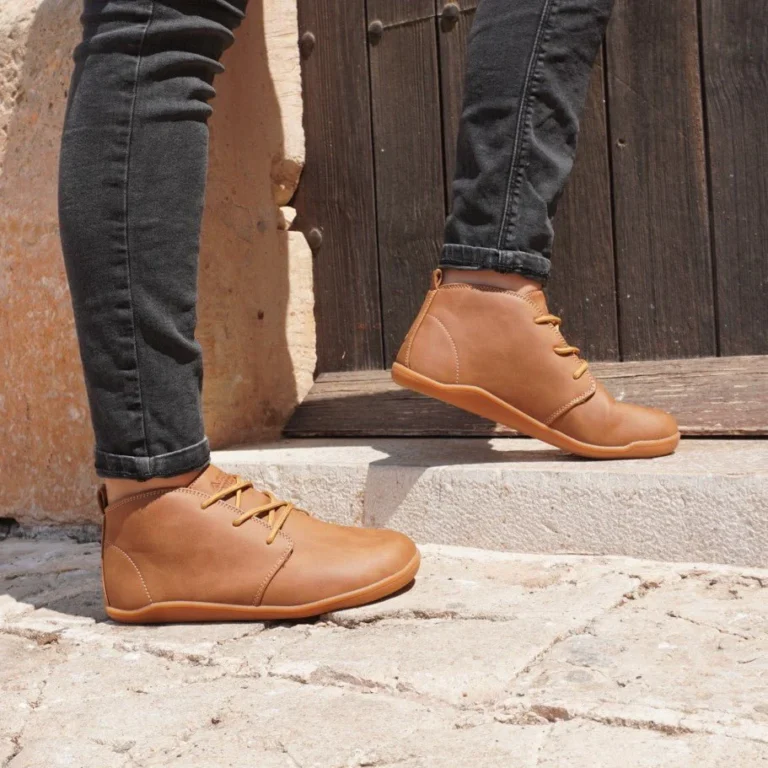
The idea that shoes should do as little as possible, allowing the foot to do its own work, is gaining solid ground in the world of men’s footwear. Barefoot shoes for men meet this need with a precise technical proposition: footwear that respects the natural biomechanics of the male foot, suitable for different use contexts and capable of contributing to overall physical wellbeing over the long term.
The male foot and its specific needs
The male foot tends to be wider, with more robust toes and greater overall volume compared to the female foot. Traditional men’s footwear, while generally less problematic than women’s in terms of induced deformities, still presents characteristics that limit the foot’s natural functioning.
High drop in traditional men’s running shoes, often between 8 and 12 millimeters, alters the mechanics of the stride by encouraging heel strike instead of the more natural forefoot or midfoot landing. Over time, this movement pattern can contribute to overloading the knee and hip joints.
Massive soles typical of traditional hiking and trail footwear reduce proprioceptive sensitivity and the foot’s ability to dynamically adapt to terrain, compensated by a structural rigidity that effectively substitutes muscular work instead of supporting it.
Sport performance and barefoot: what research says
The debate on the effectiveness of barefoot shoes in male athletic performance is rich and articulated. Available data offers some reasonably solid conclusions.
For medium to long distance running, studies show that runners who have successfully completed the transition to minimalist footwear develop a more energetically efficient stride, with better utilization of the natural elasticity of the Achilles tendon and foot as a spring structure. This does not automatically translate into faster times, but can contribute to greater running economy over the long term.
For weightlifting and gym training, barefoot shoes offer an immediate and measurable advantage: the flat sole and direct ground contact improve stability during pushing movements like squats and deadlifts, optimizing force transfer to the ground. Many strength athletes have adopted minimalist footwear or barefoot practice for these exercises precisely for this reason.
For hiking and outdoor activities, the proprioceptive benefits of thin soles translate into better terrain reading and more reactive response to unstable footing, with potential advantages in terms of ankle sprain prevention.
Models and use contexts
The range of men’s barefoot shoes available today covers almost every imaginable use context.
For running there are models with lightweight rubber soles and breathable mesh uppers, designed for different surfaces and with varying levels of ground protection. Models with added protection under the toes are suitable for rocky trails, while those with completely smooth soles maximize proprioceptive sensitivity on more uniform surfaces.
For daily use the choice has expanded enormously, with models ranging from casual to lines with a cleaner aesthetic suitable for semi-formal settings. The key is finding the model with the right width in the toe area: a wide male foot in a narrow upper negates all the benefits of minimalism.
For the outdoors there are versions with Vibram or equivalent rubber soles, resistant to abrasion and with a grip profile suited to natural terrain, while maintaining the flexibility and zero drop characteristics that define minimalism.
The community aspect
One characteristic of the barefoot world worth mentioning is the strength of the community that has formed around this philosophy. Online forums, minimalist running groups, channels dedicated to foot rehabilitation: those who approach barefoot shoes find resources and people willing to share their experience generously and constructively.
This community is a practical and valuable resource for beginners: it helps avoid the most common transition mistakes, find advice specific to one’s use context and stay motivated through a phase that can be physically demanding and requires patience and consistency.

0 Comments