

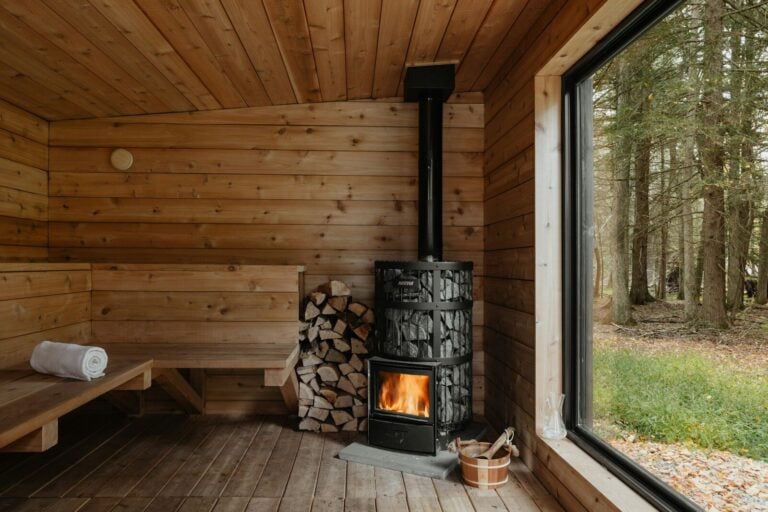
The quality of firewood plays an important role in how efficiently a wood-heated sauna operates. Even a properly installed stove may struggle to reach the desired temperature when the fuel contains too much moisture or is stored incorrectly.
For owners of traditional outdoor saunas, understanding how to select, dry, and store firewood can make heating more predictable. It also helps reduce smoke, unnecessary fuel consumption, and maintenance problems.
Unlike electric heaters, which maintain temperature through automatic controls, wood-burning systems require attention to fuel quality and combustion conditions.
Why Firewood Moisture Matters
Freshly cut wood contains a considerable amount of water. When it burns, part of the heat produced by combustion is used to evaporate this moisture instead of warming the stove and sauna stones.
As a result, wet firewood can cause several problems:
- Longer heating times.
- Lower combustion efficiency.
- Increased smoke production.
- Greater accumulation of deposits in the chimney.
- Difficulty maintaining a consistent fire.
For most residential wood-burning appliances, firewood with a moisture content below approximately 20% is generally recommended.
A moisture meter provides a more reliable measurement than judging wood by appearance. For an accurate reading, a log should be split and tested on the freshly exposed interior surface.
Choosing Suitable Types of Firewood
Different wood species have different densities and burning characteristics.
Dense hardwoods such as oak, maple, and birch generally provide more energy per unit of volume than lighter woods. They can produce longer-lasting fires when properly seasoned.
Softwoods such as pine and spruce are often easier to ignite and can be useful when starting a fire. However, they typically burn faster by volume and may require more frequent refueling.
The best choice also depends on local availability and the stove manufacturer’s recommendations.
Wood species alone does not determine heating performance. Dry, properly sized logs usually produce better results than dense hardwood that has not been adequately seasoned.
Understanding How Heat Reaches the Sauna Room
A traditional sauna stove transfers heat to the surrounding space through several processes.
The fire heats the stove body and the stones, while hot air circulates around the room. The heated stones also provide the thermal energy needed to generate steam when water is poured over them.
The interaction between fuel quality, stone temperature, airflow, and stove design influences the overall experience.
Anyone interested in the principles behind traditional sauna heating methods can explore how wood-fired systems distribute heat and why correct installation and ventilation matter.
Understanding these principles makes it easier to recognize why simply adding more firewood does not always improve heating performance.
How Long Should Firewood Be Seasoned?
Seasoning is the process of allowing freshly cut wood to dry before it is burned.
The required drying period depends on the wood species, log dimensions, local climate, and storage conditions.
Some split firewood may reach suitable moisture levels after six to twelve months, while dense hardwoods can require considerably longer.
Several conditions help accelerate natural drying:
- Splitting logs into manageable pieces.
- Stacking wood above ground level.
- Providing good airflow around the pile.
- Protecting the upper surface from rain and snow.
- Keeping the sides sufficiently open for ventilation.
Covering an entire woodpile with an impermeable plastic sheet can trap moisture and slow the drying process.
A simple covered woodshed with open sides is often more effective.
Proper Storage Near a Sauna
Having firewood available near an outdoor sauna is convenient, particularly during cold weather.
However, the main storage pile should remain at a safe distance from the stove, chimney, and other heat sources.
Only the amount needed for immediate use should be brought into the sauna building, and combustible materials must never be placed within the stove’s required safety clearances.
Firewood should also be kept away from persistent ground moisture. Storing logs directly on soil can encourage decay and make the lower layers difficult to dry.
Regularly rotating stored firewood helps ensure older, seasoned logs are used before newer supplies.
Avoiding Common Firewood Mistakes
One common mistake is assuming that firewood is dry because its outer surface feels dry.
Large logs can retain considerable moisture internally, even after months of storage.
Another mistake is using painted, pressure-treated, glued, or otherwise chemically processed wood. Such materials can release hazardous pollutants when burned and should never be used as sauna fuel.
Homeowners should also avoid overloading the firebox. Adding excessive amounts of wood can overheat the stove, chimney, and nearby construction materials.
The safest approach is to follow the stove manufacturer’s instructions for log dimensions, fuel quantity, and operating procedures.
Maintaining Consistent Heating Performance
Efficient sauna heating depends on more than selecting a suitable tree species.
Dry fuel, correct storage, controlled combustion, and routine chimney maintenance all contribute to reliable operation.
A properly prepared firewood supply makes sauna sessions easier to manage and helps reduce avoidable problems with smoke and heating efficiency.
For owners who use their sauna regularly, developing consistent firewood preparation and storage habits is one of the simplest ways to support dependable performance throughout the year.

0 Comments