

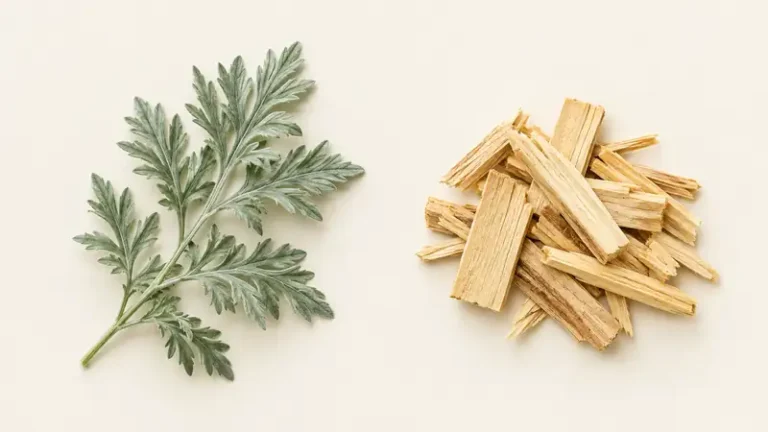
Wormwood vs quassia extract is not a comparison between two versions of the same bitter ingredient. Wormwood is an aromatic aerial herb from the Asteraceae family. Quassia usually refers to bitter wood from a tropical tree or shrub in the Simaroubaceae family. Their plant parts, marker compounds, flavor profiles, extraction behavior, and safety questions differ.
HerbEra uses a label-first editorial approach for comparisons like this. Before evaluating bitter drops, identify the botanical species, plant part, extract type, solvent, amount per serving, marker compounds, and warnings.
Are Wormwood and Quassia Interchangeable?
No. Wormwood and quassia should not be substituted drop for drop or gram for gram. A similar bitter taste does not establish equivalent composition, concentration, or suitability.
| Comparison point | Wormwood | Quassia |
|---|---|---|
| Typical botanical identity | Artemisia absinthium L. | Quassia amara L. or another species sold under a quassia common name |
| Botanical family | Asteraceae | Simaroubaceae |
| Common plant part | Herb or aerial parts | Usually wood or stem wood, although some labels specify bark |
| Characteristic bitter compounds | Absinthin and related sesquiterpene lactones | Quassin, neoquassin, and related quassinoids |
| Flavor profile | Sharp, dry, herbal, and aromatic | Clean, woody, intense, and persistent |
| Thujone | May occur in the volatile fraction | Not a characteristic constituent |
| Key label question | Plant part, solvent, and thujone specification | Exact species, plant part, and quassinoid information |
What Is Wormwood Extract?
Wormwood extract comes from Artemisia absinthium, a member of the Asteraceae family. Supplement labels commonly identify the ingredient as wormwood herb, aerial parts, leaf, or flowering aerial parts. These terms are related but not identical.
Primary bitter profile
Wormwood owes much of its intense bitterness to sesquiterpene lactones, especially absinthin. It also contains flavonoids, phenolic compounds, and a variable volatile fraction. The volatile fraction gives wormwood its recognizable aromatic character.
Thujone variability
Some wormwood material contains alpha-thujone and beta-thujone. The amount depends on plant chemotype, growing conditions, harvest, storage, and extraction method. A product’s bitter taste cannot reveal its thujone level because absinthin and thujone are different compounds.
Water, glycerin, and ethanol do not extract every constituent in the same way. An alcohol-free glycerite may therefore differ from an ethanolic tincture even when both start with the same botanical material.
What Does Quassia Mean on a Label?
Quassia is less precise than it may appear. The name commonly refers to Quassia amara, a tropical shrub or small tree in the Simaroubaceae family. Some products and older references use quassia for Picrasma excelsa, which has also been called Jamaica quassia.
Species identity
A label that lists only quassia leaves the species unclear. Look for the complete Latin name. Quassia amara and Picrasma excelsa are accepted species in different genera, even though their common names can overlap.
Plant part
Quassia preparations often use wood or stem wood. Bark may also appear in commerce. The label should identify the actual plant part because wood, bark, and leaf material are not automatically equivalent.
Marker compounds
Quassia’s bitterness comes from quassinoids. Quassin and neoquassin are commonly discussed markers, but their amounts vary by species, raw material, and extraction process. A statement such as quassia extract does not disclose the quassinoid concentration.
Why Does Similar Bitterness Not Mean Equivalent Extracts?
Bitterness is a sensory property, not a unit of concentration. Two liquids can taste similarly bitter while containing different compounds at different amounts.
Wormwood combines intense bitterness with volatile aromatic notes. Quassia tends to provide a cleaner and more persistent woody bitterness. Glycerin, sweeteners, citrus peel, ginger, and other ingredients can change how either extract tastes.
A person may also perceive bitterness differently from another person. Serving temperature, dilution, food intake, and repeated exposure can alter the sensory experience. Taste cannot confirm botanical identity, purity, extract ratio, or marker content.
| Reason substitution is unreliable | What can change |
|---|---|
| Different plant families | The two ingredients contain different groups of characteristic compounds |
| Different plant parts | Aerial herb and dense wood behave differently during extraction |
| Different solvents | Water, glycerin, and ethanol produce different extract profiles |
| Different extract ratios | The amount of starting material represented in each milliliter can vary |
| Different marker compounds | Absinthin, thujone, quassin, and neoquassin require separate evaluation |
| Different formula types | A single-herb extract cannot be compared directly with a proprietary blend |
How Does the Extraction Format Affect Bitter Drops?
A traditional tincture uses ethanol and water. A glycerite uses vegetable glycerin, usually with water. Some brands use the phrase alcohol-free tincture for a glycerin-based extract, so the Other Ingredients panel matters.
Wormwood extraction
Wormwood contains both nonvolatile bitter compounds and volatile constituents. Solvent strength, temperature, extraction time, and plant material influence which compounds enter the finished liquid. Alcohol-free does not automatically mean thujone-free.
Quassia extraction
Quassinoids are intensely bitter compounds found in dense woody material. The cut size, solvent, temperature, and herb-to-extract ratio can affect the finished extract. A concentrated quassia preparation should not be estimated from taste alone.
Drop counts are also imperfect comparison units. Drop size changes with viscosity and dropper design. Milliliters, milligrams, extract ratios, and marker specifications provide more useful information.
How Should You Compare Bitter-Drop Labels?
Start with botanical identity. A wormwood label should specify Artemisia absinthium. A quassia label should state whether the source is Quassia amara, Picrasma excelsa, or another clearly identified species.
When comparing HerbEra’s alcohol-free wormwood liquid extract with quassia drops, establish whether the second product contains quassia alone or a mixture of bitter herbs. Then compare plant parts, solvents, serving amounts, extract ratios, and warnings.
For wormwood, look for thujone information or access to relevant batch testing. For quassia, look for quassin, neoquassin, total quassinoids, or another stated quality marker. The absence of standardization does not automatically indicate poor quality, but it limits precise comparison.
Read the full ingredient list for glycerin, water, ethanol, flavors, sweeteners, preservatives, and additional botanicals. A front label that says bitter drops may describe a single extract, a flavored glycerite, or a complex proprietary blend.
What Safety Differences Matter?
Wormwood requires attention to thujone. European herbal assessments advise preference for low-thujone material and recognize uncertainty around exposure from different preparations. Concentrated wormwood essential oil is not interchangeable with a tea, capsule, tincture, or glycerite.
Quassia requires a different review. European scientific assessments have identified reproductive toxicology concerns and important data gaps for quassin-containing materials. Findings from a specific food-use or laboratory assessment do not create a universal serving limit for every supplement.
Pregnant or breastfeeding people should not casually use concentrated wormwood or quassia products. People with a seizure history, ongoing medication use, allergies, or significant health concerns should ask a qualified clinician or pharmacist to review the complete formula.
Wormwood belongs to the Asteraceae family, while quassia belongs to the Simaroubaceae family. An allergy to one family does not establish an allergy to the other, but each ingredient still requires individual consideration.
Wormwood and Quassia Label Checklist
Use this checklist before comparing two bitter-drop formulas. It helps separate verifiable product details from assumptions based on taste or front-label wording.
Confirm the species
Look for the complete Latin name. Do not accept Artemisia or quassia alone as precise botanical identification.
Identify the plant part
Check for wormwood aerial parts and the specific quassia wood, stem wood, bark, or other material.
Read the solvent
Determine whether the extract uses ethanol, glycerin, water, or a combination.
Compare the extract ratio
Use the herb-to-extract ratio with the serving amount. Do not compare products only by their number of drops.
Find marker information
Check thujone details for wormwood and quassinoid details for quassia when available.
Check for a blend
Identify every additional botanical and determine whether individual amounts are disclosed.
Review warnings
Follow the stated age limits, serving directions, allergy notes, medication cautions, and storage instructions.
FAQ
Are wormwood and quassia the same plant?
No. Wormwood is Artemisia absinthium. Quassia commonly refers to Quassia amara or another species sold under a similar common name.
Can quassia replace wormwood in bitter drops?
Not on a 1:1 basis. Their plant parts, marker compounds, extraction behavior, and safety questions differ.
Which ingredient is more bitter?
Both can taste extremely bitter. Concentration, solvent, formulation, and individual taste perception make a universal ranking unreliable.
Does quassia contain thujone?
Thujone is not a characteristic quassia constituent. Quassia is associated with quassinoids such as quassin and neoquassin.
Does alcohol-free wormwood contain no thujone?
Not necessarily. Finished-product testing or a clear specification is needed to assess thujone content.
Why must a quassia label include the species?
The common name can refer to more than one botanical source. The Latin name clarifies which plant the product contains.
Can taste confirm extract strength?
No. Sweeteners, solvents, added herbs, extract ratios, and natural plant variation all affect perceived bitterness.
Glossary
Absinthin
A strongly bitter sesquiterpene lactone found in wormwood.
Aerial parts
The portions of a plant that grow above the ground, including leaves and stems.
Botanical identity
The verified genus, species, and plant part of an herbal ingredient.
Extract ratio
The relationship between the amount of starting botanical material and the finished extract.
Glycerite
A liquid botanical extract made mainly with vegetable glycerin and water.
Quassin
An intensely bitter quassinoid associated with quassia wood.
Quassinoids
A group of bitter plant compounds characteristic of many Simaroubaceae species.
Thujone
A volatile compound that may occur in wormwood and requires separate specification.
Conclusion
Wormwood and quassia may share intense bitterness, but they are not equivalent extracts. Compare their exact species, plant parts, solvents, marker compounds, serving amounts, and safety information before evaluating a formula.
Sources Used
European Union herbal monograph and assessment report for wormwood herb – ema.europa.eu/en/medicines/herbal/absinthii-herba
Scientific opinion on quassin and quassia extracts – food.ec.europa.eu/system/files/2020-12/sci-com-scf-out134
Taxonomic record for Quassia amara – powo.science.kew.org/taxon/quassia-amara
Taxonomic record for Picrasma excelsa – powo.science.kew.org/taxon/picrasma-excelsa
Dietary Supplement Labeling Guide, Chapter IV – fda.gov/food/dietary-supplements-guidance-documents-regulatory-information/dietary-supplement-labeling-guide-chapter-iv-nutrition-labeling

0 Comments