


The Business Value of Website Optimization and Maintenance
In the bustling digital world of July 2026, your website is more than just an online brochure; it’s your virtual storefront, your primary communication channel, and often your most powerful sales tool. Many business owners believe that once a website is live, the hard work is over. However, just like a physical store, a website requires continuous attention to thrive.
Neglecting your digital presence can lead to a host of problems. These include sluggish performance, frustrating security vulnerabilities, and a significant drop in customer engagement. This can mean lost revenue. Proactive website optimization and maintenance are not optional; they are fundamental to ensuring your online success and protecting your investment.
In this comprehensive guide, we will explore the essential strategies for keeping your website at its peak. We will delve into the critical tasks involved, shed light on the costs associated with professional services in 2026, and help you decide between a do-it-yourself approach and hiring experts. We will also examine how regular upkeep directly boosts your website’s speed, security, and crucially, its search engine rankings. For businesses aiming to stand out online, a well-maintained site is critical for search engine performance. Many find that expert guidance through SEO consulting services can further enhance their visibility and growth.
A website’s value extends far beyond its initial design and launch. Its true worth is realized through its consistent performance, reliability, and ability to meet user expectations. This is where website optimization and maintenance become indispensable. Think of your website as a crucial business asset that, like any other, requires regular care to deliver maximum return on investment. The goal is to ensure continuous uptime, aiming for the industry benchmark of 99.9% uptime, which means your site is almost always available to potential customers. Consistent availability builds customer retention, improves conversion rates, and reinforces your brand reputation as reliable and professional.
Why Small Businesses Need Website Optimization and Maintenance
For small businesses, a website often serves as the most critical digital storefront. It’s the first point of contact for many potential customers, a platform for showcasing products and services, and a vital channel for lead generation and sales. Unlike larger enterprises with dedicated IT departments, small businesses often operate with limited resources, making the impact of a poorly performing website even more detrimental.
Regular maintenance fosters customer trust. A fast, secure, and functional website tells visitors that you value their experience and take your online presence seriously. Conversely, a slow or broken site can quickly erode trust, driving potential customers to competitors. Moreover, an optimized website is a powerful sales channel, working 24/7 to attract, inform, and convert visitors into loyal customers. Neglecting this aspect is akin to leaving your physical store unattended, risking both its appearance and security.
Key Risks of Neglecting Digital Infrastructure
The consequences of neglecting website maintenance are far-reaching and can significantly impact a business’s bottom line. One of the most immediate risks is downtime. Even a few hours of your website being offline can lead to lost sales, damaged credibility, and a frustrating experience for users. This is particularly critical when considering that 53% of visitors will abandon a page if it takes longer than three seconds to load, according to Google. Frequent downtime or slow loading speeds can quickly translate into lost traffic and revenue.
Beyond performance, security breaches pose an existential threat. Small businesses are increasingly targeted, with statistics showing that 43% of cyberattacks specifically target small businesses. Neglecting security updates, patching vulnerabilities, and monitoring for malicious activity leaves your website — and your customer data — exposed. A breach can result in data loss, financial penalties, and irreparable damage to your brand’s reputation.
Other risks include lost traffic due to broken links, outdated content, or poor search engine rankings. Expired domains, a surprisingly common oversight, can lead to your website disappearing entirely, sometimes being snatched up by competitors. These issues not only deter visitors but also signal to search engines that your site is not well-maintained, negatively impacting its visibility. Proactive maintenance is not just about preventing problems; it’s about safeguarding your business’s online future.
Core Technical Pillars of Site Health
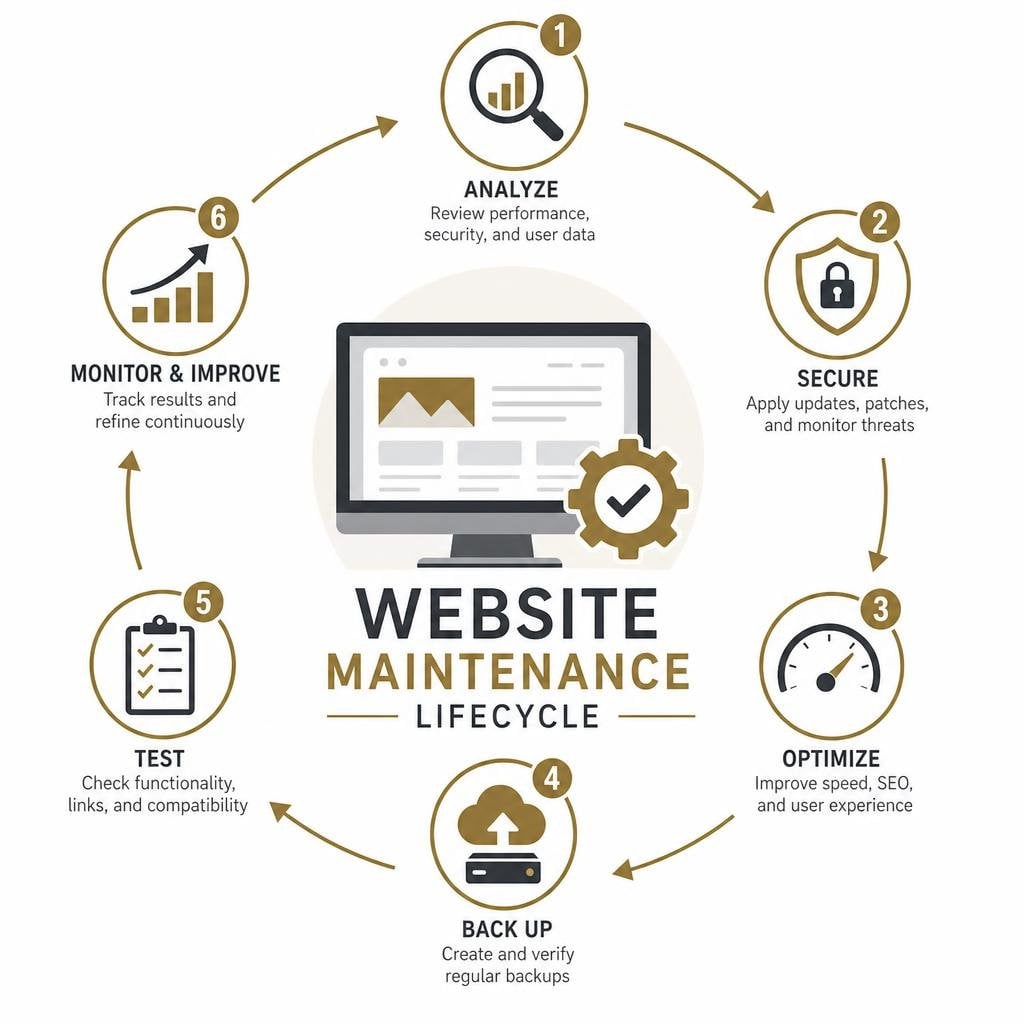
Maintaining a healthy website involves a multi-faceted approach, focusing on several technical pillars that ensure optimal functionality, security, and performance. These pillars include regular software updates, robust security protocols, and continuous performance optimization. Addressing these areas systematically is key to a stable and effective online presence.

A Checklist for Ongoing Website Optimization and Maintenance
Effective website maintenance is best approached with a structured schedule, ensuring no critical tasks are overlooked. This chronological checklist helps distribute the workload and keeps your site running smoothly.
- Weekly Tasks:
- Backups: Perform full website and database backups. This is your safety net against data loss.
- Security Scans: Run comprehensive security scans to detect malware, vulnerabilities, or unauthorized changes.
- Uptime Monitoring: Verify your website is consistently online and accessible.
- Form Testing: Ensure all contact forms, checkout processes, and interactive elements are functioning correctly.
- Analytics Review: Check basic traffic patterns and identify any sudden drops or spikes that might indicate an issue.
- Monthly Tasks:
- Software Updates: Update your Content Management System (CMS) (e.g., WordPress, Joomla), themes, and plugins to their latest versions. Always test these updates in a staging environment first to prevent conflicts.
- Performance Checks: Monitor page load times and Core Web Vitals using tools like Google PageSpeed Insights. Address any identified bottlenecks.
- Broken Link Checks: Scan for and fix any broken internal or external links, which can harm user experience and SEO.
- Database Optimization: Clean up your database by removing old revisions, spam comments, and unnecessary data to improve performance.
- Spam Comment Cleanup: Delete any spam comments that may have slipped through filters.
- Quarterly Tasks:
- Content Review and Optimization: Update outdated content, check for accuracy, and optimize existing pages for relevant keywords. This is an excellent opportunity to refine your content strategy and ensure it aligns with your overall digital marketing goals. For businesses looking to maximize their online presence, a deeper dive into their digital strategy through specialized guidance can be incredibly beneficial.
- SEO Health Check: Review your meta titles, descriptions, image alt tags, and overall on-page SEO. Check for crawl errors in Google Search Console.
- Accessibility Testing: Ensure your website remains accessible to users with disabilities, complying with standards like WCAG.
- User Experience (UX) Review: Evaluate the user journey, navigation, and overall site usability. Consider minor design tweaks for improved engagement.
- Review Security Logs: Analyze detailed security logs for any unusual activity or attempted breaches.
- Annual Tasks:
- Domain and Hosting Renewal: Ensure your domain name and web hosting subscriptions are renewed well in advance to prevent service interruption. Consider setting up auto-renewal.
- Comprehensive Website Audit: Conduct a thorough audit of your entire site, including performance, security, SEO, and content strategy. This is a good time to evaluate your web design and hosting plans for potential upgrades.
- Review Privacy Policy and Terms & Conditions: Update these legal documents to comply with the latest regulations (e.g., GDPR, CCPA).
- Strategy Review: Assess your website’s performance against your business goals for the year. Plan for major updates, redesigns, or new features in the coming year.
Adhering to this schedule, and perhaps seeking expert SEO consulting services for in-depth analysis and strategy, can significantly prolong the lifespan and effectiveness of your digital asset.
Security Protocols and Threat Mitigation
In an era where cyber threats are constantly evolving, robust security protocols are paramount for any website. As mentioned, 43% of cyberattacks target small businesses, highlighting the urgent need for proactive defense.
- SSL Certificates and HTTPS: Implementing an SSL (Secure Sockets Layer) certificate is non-negotiable. It encrypts data exchanged between your website and its visitors, protecting sensitive information and building trust. Google also prioritizes secure websites (HTTPS) in its search results, making it an SEO imperative.
- Regular Software Updates: Keeping your CMS, themes, and plugins updated is the first line of defense. Developers frequently release updates to patch newly discovered vulnerabilities. Neglecting these updates leaves your site exposed to known exploits.
- Malware Scanning and Removal: Regular malware scans help detect and remove malicious code before it can cause significant damage. Many hosting providers offer this as part of their packages, or you can use third-party security plugins.
- Strong Passwords and User Management: Enforce strong, unique passwords for all user accounts and limit administrative access to only those who absolutely need it. Regularly review user roles and permissions.
- Web Application Firewalls (WAFs): A WAF acts as a shield between your website and the internet, filtering out malicious traffic and protecting against common attacks like SQL injection and cross-site scripting (XSS).
- DDoS Protection: Distributed Denial of Service (DDoS) attacks can overwhelm your server with traffic, causing downtime. Implementing DDoS protection helps mitigate these attacks.
- Backup and Recovery: Even with the best security measures, breaches can occur. A reliable backup strategy ensures that you can quickly restore your website to a clean, pre-attack state, minimizing downtime and data loss.
For websites built on platforms like WordPress, which powers a significant portion of the internet, specialized security measures are often required. Services focusing on WordPress website security can provide tailored solutions, including hardening installations, real-time monitoring, and expert incident response, ensuring your site remains resilient against threats.
Speed Optimization and Core Web Vitals
Website speed is not just a luxury; it’s a critical component of user experience, conversion rates, and search engine rankings. As Google states, 53% of mobile users will leave a page if it takes longer than 3 seconds to load. This directly impacts your bounce rate and overall engagement.
Google’s Core Web Vitals (CWV) — Largest Contentful Paint (LCP), First Input Delay (FID), and Cumulative Layout Shift (CLS) — are key metrics that measure the real-world user experience of loading performance, interactivity, and visual stability. Optimizing these factors is crucial for both user satisfaction and SEO.
Key strategies for speed optimization include:
- Caching: Implementing caching mechanisms stores static versions of your website, reducing server load and speeding up delivery for repeat visitors. This can be done at the server level, through a CMS plugin, or via a Content Delivery Network (CDN).
- Content Delivery Networks (CDNs): CDNs store copies of your website’s static content (images, CSS, JavaScript) on servers geographically closer to your users. This reduces latency and speeds up content delivery globally.
- Image Optimization: Large, unoptimized images are a common culprit for slow page load times. Compress images without sacrificing quality, use modern formats like WebP, and implement lazy loading so images only load when they enter the user’s viewport.
- Minify CSS and JavaScript: Removing unnecessary characters from your code files reduces their size, leading to faster download times.
- Server Response Time (TTFB): Optimize your server’s Time To First Byte (TTFB) by choosing a reputable hosting provider, optimizing your database, and using efficient server-side code.
- Minimize Render-Blocking Resources: Ensure that critical CSS and JavaScript are loaded efficiently to allow the main content of your page to render quickly.
- Accessibility Testing: While primarily focused on usability for individuals with disabilities, accessible websites are often well-structured and performant, benefiting all users and search engines.
Regularly monitoring key performance metrics such as bounce rate, page load time, and conversion rates helps identify areas for improvement and ensures your website remains fast, responsive, and engaging.
Cost Analysis: DIY vs. Professional Services
Deciding whether to handle website maintenance yourself or hire a professional service is a common dilemma for small business owners. Both approaches have their merits and drawbacks, primarily revolving around cost, time, and technical expertise.

Feature / Aspect DIY Maintenance Professional Maintenance Cost Low (time investment only, potentially tools) Variable, typically $95-$195+/month (2026) Time Commitment Significant, ongoing Minimal for business owner, handled by experts Technical Expertise Requires high level, constant learning Provided by specialists, up-to-date knowledge Security Relies on owner’s vigilance and knowledge Proactive monitoring, rapid incident response Speed/Performance Owner’s ability to diagnose and optimize Expert optimization, continuous monitoring Reliability Prone to human error, potential for missed tasks Structured processes, staging environments, guarantees Emergency Support Owner’s responsibility, potentially slow Fast response times, dedicated support Focus Diverts focus from core business activities Frees up owner to focus on business growth Scalability Limited by owner’s capacity Scales with business needs, access to broader skill set Factors Influencing Maintenance Pricing in 2026
The cost of professional website maintenance for small businesses in 2026 can vary significantly, generally ranging from $20 to $500+ per month. However, most small businesses find that full-service plans covering updates, security, backups, speed, and support typically fall within the $95–$195/month range. Several factors contribute to this variability:
- Website Complexity: A simple static brochure website will naturally cost less to maintain than a dynamic e-commerce platform with thousands of products, custom functionalities, and frequent transactions. Websites with custom integrations (e.g., CRM, ERP systems) or complex databases require more specialized attention.
- Platform Used: Maintenance costs can differ based on the website’s underlying platform. WordPress, while popular, requires consistent plugin and theme updates. Custom-coded sites or those on less common CMS platforms might incur higher costs due to the specialized knowledge required.
- E-commerce Support: Online stores need continuous monitoring of payment gateways, shopping carts, and product pages to prevent lost sales. This often includes specific security measures and performance tuning, leading to higher maintenance fees.
- Scope of Services: Basic plans might only cover core updates and backups, while comprehensive plans include advanced security monitoring, speed optimization, content updates, SEO checks, and priority technical support. The more services included, the higher the monthly fee.
- Response Times and Guarantees: Providers offering rapid emergency support (e.g., 24/7 monitoring with guaranteed fix times) or uptime guarantees typically charge more for the added peace of mind and dedicated resources.
- Reporting and Communication: Services that provide detailed monthly reports, performance analytics, and regular consultations add value and are usually priced accordingly.
- Agency vs. Freelancer: Larger agencies might offer more comprehensive services and dedicated teams but often come with a higher price tag compared to independent freelancers.
Understanding these pricing factors helps businesses align their budget with their specific website needs, ensuring they get the most value from their maintenance investment.
Choosing the Right Service Provider
Selecting the right website maintenance service or provider is a critical decision that can significantly impact your business’s online success. It’s not just about finding the cheapest option, but about finding a partner who understands your needs and can deliver reliable results.
Here are key considerations when making your choice:
- Define Your Needs: Before you start looking, clearly outline what you need. Do you require basic updates and backups, or do you need comprehensive support including speed optimization, SEO checks, and content edits?
- Experience and Expertise: Look for providers with a proven track record, especially with websites similar to yours in terms of platform and complexity. Ask for case studies or testimonials.
- Service Level Agreements (SLAs): A clear SLA outlines the scope of services, response times for emergencies, and guarantees for uptime and issue resolution. This provides transparency and accountability.
- Proactive vs. Reactive: Choose a provider that emphasizes proactive maintenance, identifying and fixing potential issues before they become problems, rather than just reacting to emergencies.
- Transparent Reporting: The best providers offer regular, easy-to-understand reports on tasks performed, performance metrics, and security checks. This keeps you informed about your website’s health.
- Emergency Support: In the event of a critical issue, how quickly can they respond? Look for services that offer rapid emergency support, ideally within 24 hours, with priority handling for active clients.
- Communication: Effective communication is key. Will you have a dedicated point of contact? How will they communicate updates and issues?
- Cost vs. Value: While budget is a factor, focus on the value provided. A slightly higher monthly fee for a comprehensive service that prevents costly downtime or security breaches can be a worthwhile investment.
- Scalability: Can the service adapt as your business grows and your website’s needs evolve?
To make an informed decision, we recommend conducting an initial audit of your website’s current health, security, and speed. Then, compare website maintenance providers using a structured checklist, asking specific questions about their processes, tools, and support. Establish automated secure backups with quick restore capabilities as a baseline requirement, and ensure they implement 24/7 security scanning and malware protection. Regular speed optimization and testing updates on a staging site before pushing them live should also be non-negotiable aspects of their service.
Frequently Asked Questions about Website Maintenance
We often encounter similar questions from business owners regarding website maintenance. Here, we address some of the most common concerns, providing expert answers to help you navigate this essential aspect of your online presence.
How much does professional website maintenance cost in 2026?
As of July 2026, professional website maintenance costs for small businesses typically range from $20 to $500+ per month. However, for a truly comprehensive, full-service plan that includes essential updates, robust security, regular backups, speed optimization, and responsive support, most small businesses should expect to pay between $95 and $195 per month.
Cheaper plans, often in the $20-$50 range, tend to be automated solutions that cover very basic updates and backups, leaving the business owner responsible for security monitoring, performance tuning, and content edits. On the higher end, complex e-commerce sites or those with extensive custom features might require premium care starting at $395+ per month. The pricing tiers depend heavily on the website’s complexity, the platform it’s built on, and the depth of services included in the package. Investing in a plan that aligns with your specific needs is crucial for balancing budget with essential website health.
How does regular maintenance improve search engine rankings?
Regular website maintenance directly contributes to improved search engine rankings by addressing key factors that search algorithms prioritize:
- Speed and Performance: Search engines, especially Google, heavily favor fast-loading websites. Regular maintenance, including caching, image optimization, and database cleanup, ensures your site meets Core Web Vitals, leading to better rankings.
- Security (HTTPS): Search engines prioritize secure websites. Implementing and maintaining SSL certificates ensures your site uses HTTPS, which is a ranking signal. Neglecting security can lead to your site being flagged as unsafe, severely impacting its visibility.
- Uptime and Reliability: A website that is frequently down or experiences errors will be penalized by search engines. Consistent uptime monitoring and prompt issue resolution ensure your site is always accessible to crawlers and users.
- Broken Links and Errors: Regular checks for broken links and other technical errors (e.g., 404s, server errors) maintain a clean site structure, making it easier for search engine bots to crawl and index your content.
- Fresh and Optimized Content: Quarterly content reviews and updates ensure your information remains relevant and keyword-optimized, signaling to search engines that your site is active and valuable.
- Mobile Responsiveness: Maintenance often includes ensuring your site remains mobile-friendly, a critical ranking factor given the prevalence of mobile browsing.
- User Experience (UX): A well-maintained site offers a superior user experience, characterized by easy navigation, fast loading, and secure interactions. Search engines indirectly reward good UX through metrics like lower bounce rates and longer dwell times.
By consistently maintaining these elements, your website becomes more appealing to search engines, leading to better crawlability, indexing, and ultimately, higher positions in search results.
What is the industry benchmark for website uptime?
The generally accepted industry benchmark for website uptime is 99.9%. This figure is considered the standard for reliable web hosting and maintenance services. While 100% uptime is an ideal that is virtually impossible to guarantee due to unforeseen technical issues, network outages, or maintenance requirements, 99.9% uptime translates to very minimal downtime over a year.
To put 99.9% uptime into perspective:
- Daily: Approximately 1 minute and 26 seconds of downtime.
- Weekly: Approximately 10 minutes and 4 seconds of downtime.
- Monthly: Approximately 43 minutes and 50 seconds of downtime.
- Annually: Approximately 8 hours and 45 minutes of downtime.
Achieving and maintaining this benchmark requires robust server reliability, proactive monitoring tools, and a responsive maintenance team. Regular monitoring helps detect and resolve issues quickly, ensuring your website remains available to your audience around the clock. Anything significantly below 99.9% uptime can lead to lost traffic, frustrated users, and a negative impact on your business’s reputation and revenue.
Conclusion
In the dynamic digital landscape of July 2026, website optimization and maintenance are not merely technical chores but strategic imperatives for business longevity and growth. Your website is a living, breathing entity that requires continuous care to remain fast, secure, and relevant. Neglecting this vital aspect can lead to a cascade of problems, from crippling security breaches and frustrating downtime to diminished search engine visibility and lost customer trust.
By embracing a proactive approach to website care, you are not just preventing problems; you are actively investing in your digital future. Regular updates, robust security protocols, and consistent performance optimization ensure your online presence is a reliable, high-performing asset that consistently attracts, engages, and converts your target audience. Whether you choose to manage it yourself or partner with a professional service, the commitment to ongoing maintenance is a commitment to your business’s long-term success. Make the smart choice today to safeguard your digital investment and ensure your website continues to thrive in the competitive online market.

0 Comments