


The Strategic Role of Digital Strategy and Software in Enterprise Growth
Technology continues to reshape industries at an unprecedented pace. As opportunities multiply for those willing to harness innovation, so do risks for those who fail to adapt. In fact, only 33% of organizations successfully meet the challenge of digital disruption. Global spending on information and communication technology (ICT) is set to reach $4 trillion in 2026, on track to surpass $6 trillion by 2029. This shows how much businesses are investing in digital tools. Yet, a reported 70% of digital initiatives fail to meet their objectives.
To truly scale and stay competitive, businesses need more than just new technologies. They require a clear digital strategy, well-executed software development, and strong online reputation management. This often includes adopting cutting-edge methods like AI-native software development to build systems that learn and adapt.
We will explore how these three crucial elements work together. We will show how they drive brand growth and create lasting value in today’s fast-moving digital economy.

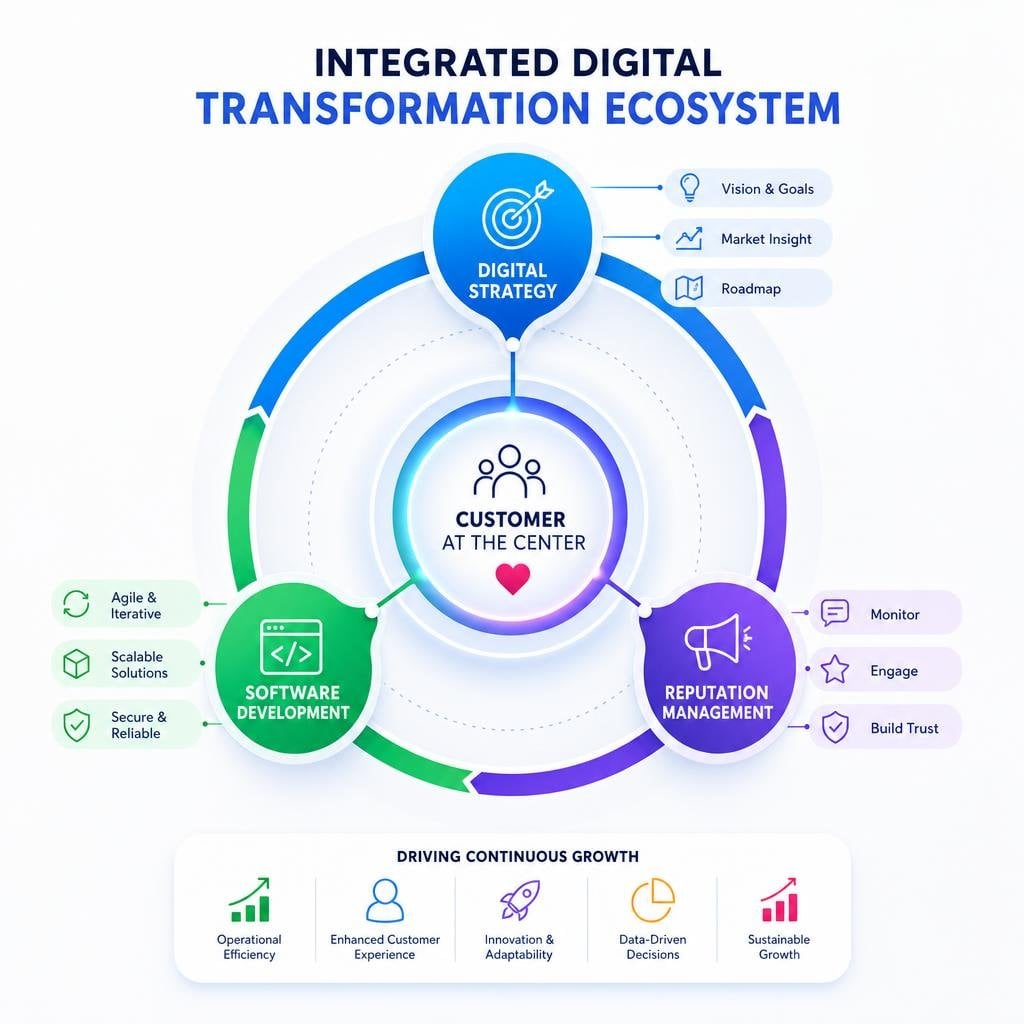
In today’s dynamic business environment, digital strategy and software are not merely supporting functions; they are central to an organization’s very existence and growth. A robust digital strategy defines how a company will leverage technology to create new value, transform operations, and establish competitive advantages that previously didn’t exist. Software, then, becomes the tangible manifestation of this strategy, enabling the execution of digital initiatives, from enhancing customer experiences to optimizing internal processes.
The synergy between digital strategy and software development is crucial for value creation. It allows businesses to adapt their models rapidly, responding to shifting market demands and consumer behaviors. For instance, a fast-casual restaurant chain that modernizes its operations and customer engagement through digital channels can see a significant uplift in digital sales, as demonstrated by Chipotle’s digital revenue growth. This strategic alignment ensures that every line of code written and every digital tool implemented serves a larger business objective, driving competitive advantage and fostering sustainable growth.

Core Pillars of Digital Strategy and Software Infrastructure
A successful digital strategy rests on several foundational pillars, each supported by robust software infrastructure. These pillars ensure that digital capabilities are not just added onto existing structures but are deeply integrated to redefine how a business operates and interacts with its ecosystem.
Firstly, customer experience is paramount. Digital strategy dictates how technology will be used to deliver seamless, personalized, and engaging interactions across all touchpoints. This requires software solutions that enable omnichannel engagement, customer data platforms, and intuitive user interfaces. Companies must assess the gap between current digital customer experience and evolving customer expectations, building unified platforms that connect behavioral data for deeper insights.
Secondly, scalable architecture forms the backbone of any growing digital enterprise. Software systems must be designed to handle increasing user loads, data volumes, and functional complexity without compromising performance. This involves cloud-native development, microservices architectures, and robust API governance to ensure interoperability and future-proofing.
Thirdly, data pipelines are essential for transforming raw data into actionable intelligence. Digital strategy emphasizes data-driven decision-making, which relies on efficient data collection, processing, storage, and analysis. Software tools for data warehousing, real-time analytics, and business intelligence are critical here, enabling organizations to leverage data to create new revenue streams and optimize operations.
Fourthly, custom engineering allows businesses to build unique, differentiating capabilities that off-the-shelf solutions cannot provide. This is where the power of specialized software development comes into play, creating bespoke applications and features tailored to specific strategic needs. This often involves innovative approaches like AI-native software development, where systems are built from the ground up to leverage artificial intelligence, enabling them to learn, adapt, and perform complex tasks autonomously.
Finally, API governance ensures that different software components and external services can communicate effectively and securely. As businesses increasingly rely on ecosystems of partners and third-party integrations, well-managed APIs are vital for fostering innovation, enabling new business models, and maintaining data integrity.
Overcoming Strategic Execution Pitfalls
Despite the clear benefits, digital initiatives are fraught with challenges. A reported 70% of digital initiatives fail to meet their objectives, and only 33% of organizations successfully navigate digital disruption. Understanding and avoiding common pitfalls is critical for success.
One major pitfall is transformation failure, often stemming from a lack of precision during the initial strategy blueprinting phase rather than execution failure. Many companies treat digital as a separate IT project rather than integrating it into their overall corporate strategy. This leads to fragmented efforts and a failure to achieve systemic change. A comprehensive digital strategy roadmap, typically formulated over 8-12 weeks, is essential to define how technology impacts the industry, business models, and potential rivals, aligning digital opportunities with overarching business goals.
Another common issue is “shiny object syndrome,” where organizations chase the latest technological trends without a clear strategic rationale. This can lead to channel proliferation without integration, resulting in disjointed customer experiences and inefficient resource allocation. Instead, leaders must prioritize digital opportunities based on potential value creation, organizational ambition, and core capabilities, ensuring that new technologies serve a defined strategic purpose.
Channel conflict can also derail digital efforts, especially in omnichannel strategies. When introducing new digital channels, businesses must deliberately manage potential conflicts with existing sales or service channels to ensure a cohesive customer journey.
Furthermore, change management is often underestimated. Digital transformation is not just about technology; it’s about people and culture. Ignoring digital culture and workforce changes can lead to significant resistance. Organizations must build organizational flexibility, upskill their workforce, and allocate sufficient resources (e.g., 30-40% of digital initiative budgets) to training, culture adoption, and leadership alignment.
Finally, operational alignment is crucial. Digital strategy must be embedded directly within the overarching business strategy. This means establishing unified governance across new digital initiatives and core operations, ensuring that the entire organization moves in a coordinated direction. Companies must audit their existing strategy along key axes like mind/machine, product/platform, and core/crowd, identifying key operational areas where AI and automation can complement human capabilities.
Building a Digital Transformation Roadmap: AI, Platforms, and Data Flywheels
A well-defined digital transformation roadmap serves as a strategic blueprint, guiding organizations through the complex journey of integrating new technologies and business models. This roadmap should not be a static document but a living plan that adapts to technological shifts and market dynamics. It typically involves an intensive 8-12 week blueprinting phase to de-risk transformations by clearly defining objectives, capabilities, and timelines.
At the heart of this roadmap are transformative technologies like artificial intelligence (AI), the strategic shift towards platform business models, and the leveraging of data flywheels. These elements are reshaping industries, enabling companies to unlock new efficiencies, create innovative products, and capture unprecedented market value.
Integrating AI Capabilities into Enterprise Workflows
Artificial Intelligence and Machine Learning (AI/ML) are no longer futuristic concepts; they are actively reshaping business strategy and operations in 2026. Their integration into enterprise workflows is a critical component of any modern digital strategy.
Generative AI, for instance, is driving primary operational shifts across global business sectors, enabling automated content creation, design, and even code generation. This can significantly boost developer productivity and accelerate product development cycles. Beyond generative AI, agentic AI and neurosymbolic AI platforms are emerging, uniting data, logic, and learning to power autonomous workflows, offering profound implications for automation and decision-making.
The application of AI extends to process automation, where intelligent systems streamline repetitive tasks, reduce errors, and free up human capital for more strategic endeavors. Machine learning algorithms enhance predictive analytics, allowing businesses to forecast market trends, personalize customer experiences, and optimize supply chains with greater accuracy.
However, integrating AI effectively also requires new disciplines. Software FinOps becomes crucial for managing the cost structures associated with AI infrastructure and operations, ensuring that AI investments deliver measurable ROI. Leaders must prioritize high-impact AI and automation use cases across key functions like marketing, sales, and innovation, ensuring that AI adoption is tied directly to business value and risk management protocols. The primary organizational challenge is learning to race ‘with’ the machine rather than ‘against’ it, complementing human workforce capabilities with intelligent automation.
Leveraging Platform Business Models and Data Flywheels
The rise of platform business models and the strategic use of data flywheels are fundamentally altering competitive landscapes across traditional industries. These models create significant network effects, where the value of a service increases as more users join, fostering rapid growth and market dominance.
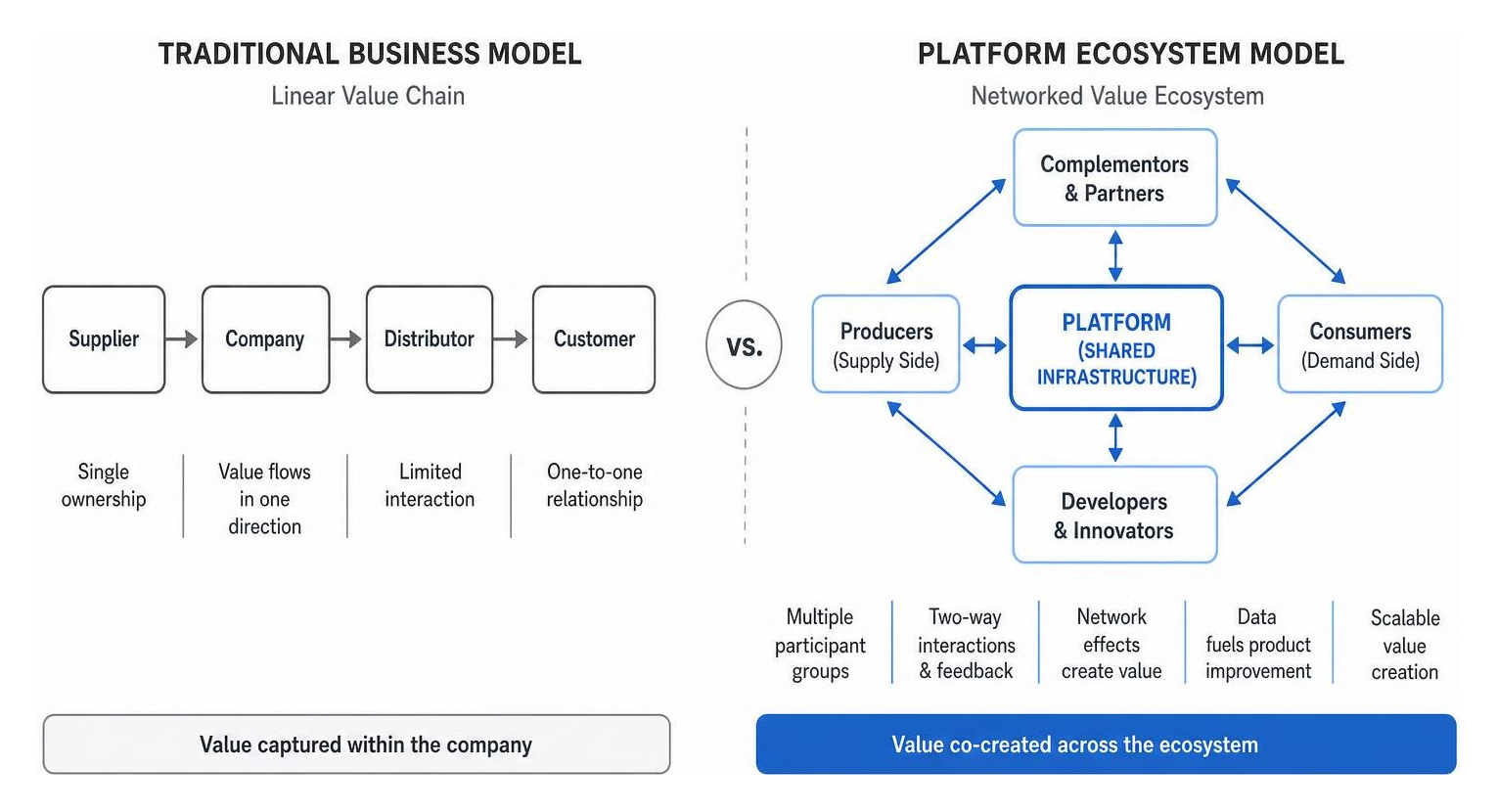
Platform ecosystems, unlike traditional linear value chains, connect multiple distinct groups of users (e.g., producers and consumers) through a common infrastructure. This creates immense network value, as each new participant adds value to all others. The five most valuable enterprise companies globally, for example, rely heavily on digital platform business models. This shift requires organizations to rebalance their focus from physical products to digital platforms and from an internal core to an external crowd.
Customer insights are a natural byproduct of platform models. The continuous interaction on platforms generates vast amounts of data, which, when analyzed, provides deep understanding of user behaviors, preferences, and needs. This fuels the data flywheel: usage improves the product, driving user acquisition, leading to more data, which further improves the product, creating a virtuous cycle.
This continuous feedback loop allows for rapid operational scaling and constant optimization. Companies can leverage this data to create new revenue streams through data monetization, personalize offerings, and refine their services. For example, a global footwear and apparel brand shifting to a direct-to-consumer digital app ecosystem saw its DTC revenue contribution significantly increase, demonstrating the power of platform-driven engagement and data.
The strategic imperative for businesses is to evaluate digital business models to open new markets and value propositions. This involves transitioning traditional product offerings toward platform-based ecosystem models where applicable and incorporating crowd-sourced or decentralized knowledge networks to supplement core centralized intelligence.
Aligning Software Development, Cultural Mindsets, and Brand Reputation
Digital transformation is as much about people and perception as it is about technology. For enterprises to truly scale their brand, it’s imperative to align software development efforts with evolving organizational culture and proactively manage their brand reputation. This holistic approach ensures that technological advancements are embraced internally and positively perceived externally.
Organizational culture plays a critical role. Digital initiatives often falter due to cultural resistance, conflicting priorities, or a lack of leadership alignment. Successful transformation requires fostering a digital leadership mindset across the entire organization, encouraging strategic experimentation, and building adaptive structures. This means investing in workforce upskilling to equip employees with the necessary digital capabilities and fostering an environment where continuous learning and rapid adaptation are the norms.
The goal is to enhance brand equity by delivering superior digital experiences and maintaining a trustworthy online presence. This involves a proactive approach to risk management, ensuring that digital innovations do not inadvertently expose the brand to reputational damage.
Integrating Brand Strategy with Software Experience
A brand’s strategy is inextricably linked to its software experience. Every digital touchpoint, from a mobile app to a website, contributes to how customers perceive and interact with the brand.
Omnichannel integration is no longer a luxury but a necessity. Customers expect seamless experiences as they move between different channels—physical stores, websites, social media, and mobile apps. Software development must support this by creating unified platforms that ensure consistent branding, personalized content, and smooth transactions. For example, a major entertainment company deployed a wearable device ecosystem integrated with a mobile app to streamline ticketing, payments, and recommendations, creating a seamless digital customer journey.
The shift towards direct-to-consumer (DTC) models, often enabled by robust e-commerce platforms and mobile applications, allows brands to build deeper relationships with their customers. This direct engagement provides invaluable insights into customer sentiment and behavior, which can then feedback into product development and marketing strategies.
Effective digital strategy leverages integrated marketing social media efforts to amplify brand messaging and engage with customers where they spend their time. This helps in building communities, gathering feedback, and reinforcing brand values. By connecting these marketing efforts directly with the software experience, companies can drive higher customer retention and optimize every touchpoint for maximum impact. This requires aligning digital marketing strategy directly with data analytics and emerging technology tools, ensuring that every interaction strengthens the brand-customer bond.
Safeguarding Brand Equity with Digital Strategy and Software Solutions
In an increasingly transparent and interconnected world, brand defense is a critical component of digital strategy. Negative online content or reputational crises can spread rapidly, causing significant damage to a brand’s equity. Proactive software solutions and strategic approaches are essential for managing a brand’s digital footprint and mitigating risks.
Digital trust is built on transparency, data security, and consistent positive experiences. Software plays a key role here, from implementing robust cybersecurity measures to ensuring ethical data handling practices. Companies must continuously monitor their online presence to safeguard against misinformation or malicious attacks.
Footprint management involves actively shaping the brand’s online narrative across various platforms. This includes search engine optimization (SEO) to promote positive content, social media monitoring to track mentions, and content strategy to establish thought leadership. When negative content appears, a swift and effective crisis response is crucial. This is where specialized software that removes negative online content can be invaluable, helping to mitigate the spread of damaging information and protect the brand’s reputation. Such tools provide a crucial layer of defense, allowing brands to address and rectify harmful narratives before they escalate.
Risk mitigation in the digital realm requires a comprehensive strategy that combines technological safeguards with proactive communication and reputation management. By integrating these elements into the broader digital strategy and software development lifecycle, businesses can build resilience, protect their brand equity, and maintain a strong, positive presence in the market.
Frequently Asked Questions
In the journey of digital transformation, leaders often grapple with fundamental questions about strategy, implementation, and measurement. Our experience shows that addressing these strategic leadership questions head-on is vital for effective executive decision-making and setting appropriate transformation benchmarks.
What is the difference between IT strategy and digital strategy?
While often used interchangeably, IT strategy and digital strategy serve distinct purposes. IT strategy primarily focuses on the technology infrastructure itself—managing hardware, software, networks, and data systems to support existing business operations efficiently and securely. It’s about optimizing the internal plumbing of an organization.
In contrast, digital strategy is about leveraging digital capabilities to fundamentally reshape customer experiences, create new digital products and services, build ecosystems, and establish competitive advantages. It focuses on how technology can create new customer value and adapt business models in response to market disruption. Digital strategy is outward-looking and value-creation oriented, whereas IT strategy is typically inward-looking and efficiency-oriented. However, the two must be in close strategic alignment for any digital initiative to succeed.
Why do 70 percent of digital transformation initiatives fail to meet objectives?
The high failure rate of digital transformation initiatives (a reported 70%) can be attributed to several critical factors, as highlighted in our research. One primary reason is conflicting priorities within the organization, where different departments or leadership teams are not aligned on the goals or direction of the transformation. This leads to disjointed efforts and a lack of unified purpose.
Another significant factor is the lack of precision during the blueprinting phase. Many organizations rush into execution without a clear, detailed digital strategy roadmap, failing to define how digital will create differential value. This often results in “digitization masquerading as digital strategy,” where existing analog processes are simply automated rather than fundamentally re-imagined.
Cultural resistance and inadequate change management also play a major role. Digital transformation demands new ways of working, new skills, and a shift in mindset. Without effective leadership, workforce upskilling, and a focus on cultural adoption, employees may resist changes, hindering progress. Finally, unscaled execution is a common pitfall. Pilots and small-scale projects may show promise, but the inability to scale these successes across the entire enterprise due to organizational silos, insufficient resources, or lack of integration leads to overall failure.
How should enterprise leaders prioritize digital investments and measure ROI?
Prioritizing digital investments and measuring their Return on Investment (ROI) requires a strategic and disciplined approach. Leaders should begin by defining a clear digital vision that aligns with overarching business goals, identifying how digital impacts their industry, business models, and potential rivals.
Investments should be prioritized based on their potential for value creation, organizational ambition, and core capabilities. This involves conducting a gap analysis to identify necessary capabilities, organizational structures, and system upgrades. A best practice is to benchmark digital experience against top global digital leaders, not just direct sector competitors, and ensure that a significant portion (e.g., at least 30%) of digital investment goes toward creating new digital value rather than just digitizing legacy processes.
Measuring success goes beyond traditional financial metrics. While total shareholder return and customer lifetime value are crucial, leaders should also track metrics related to customer experience, operational efficiency gains, market share growth, and new revenue streams generated by digital initiatives. Companies that successfully transform digitally achieve an average of 14 extra points of total shareholder return.
A strategic investment benchmark suggests that digital leaders typically make strategic investments equal to roughly 10% of their market capitalization. Implementing agile governance allows for continuous measurement, adaptation, and iteration of digital tactics. This ensures that the digital strategy remains relevant and responsive, with annual overhauls to account for rapid technological shifts. It’s about balancing a portfolio of small digital bets with high-impact large investments, always ensuring executive alignment and clear accountability.
Conclusion
In the rapidly evolving digital landscape of 2026 and beyond, the interplay between a well-articulated digital strategy, robust software development, and diligent reputation management is non-negotiable for enterprise growth. We have seen that merely adopting new technologies is insufficient; success hinges on a holistic approach that integrates digital capabilities into the core of business operations, customer experiences, and brand identity.
Achieving strategic alignment means embedding digital initiatives directly within the overarching corporate strategy, moving beyond treating them as isolated IT projects. This requires a clear roadmap, an understanding of emerging technologies like AI and platform models, and a commitment to continuous organizational adaptation. Software development acts as the engine, translating strategic vision into tangible solutions that drive value creation and competitive advantage.
Furthermore, managing a brand’s online presence and safeguarding its equity has become paramount. By integrating brand strategy with software experience and leveraging tools for reputation defense, companies can build trust, foster customer loyalty, and mitigate risks in an interconnected world.
Success in this digital era is about embracing continuous evolution. Organizations must be agile, willing to experiment, learn from failures, and adapt their strategies and software solutions in real-time. Those that master this intricate balance of digital strategy, software innovation, and brand stewardship will not only achieve strong competitive positioning but also unlock unprecedented opportunities for sustained enterprise growth.

0 Comments