

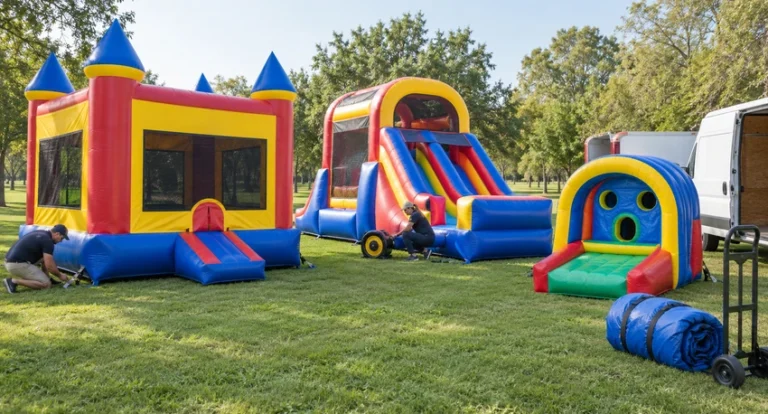
Starting a bounce house rental business involves more than purchasing a few colorful inflatables. Every product affects transportation, setup time, staffing, storage, maintenance, and the types of events the company can serve.
New operators should therefore choose equipment according to local demand and their actual operating capacity. This checklist explains the essential products, accessories, and business systems needed to build a practical rental operation.
Research Your Local Rental Market
Before purchasing equipment, identify the customers and events available in your service area. A company serving backyard birthday parties will need a different inventory from one targeting schools, churches, corporate events, or community festivals.
Review nearby rental businesses to understand:
- Popular products and themes
- Typical rental prices
- Delivery areas
- Customer reviews
- Seasonal demand
- Products that appear to be unavailable locally
Also consider the size of common event spaces. A large attraction may look impressive online but may not fit many residential yards. Smaller inflatables are usually easier to transport, although they may be less suitable for high-attendance events.
This research helps operators select products that match real demand rather than buying equipment based only on appearance.
Build a Balanced Starter Inventory
A new rental business does not need a large collection immediately. Starting with a smaller selection of versatile commercial inflatables can reduce transportation, storage, and maintenance demands.
A practical starter inventory might include:
- One traditional bounce house
- One bounce-and-slide combination unit
- One medium-sized slide
- One compact interactive game
Each product should serve a different purpose.
Traditional bounce houses are suitable for many children’s parties. Combination units offer several activities in one attraction and may appeal to customers seeking more entertainment value. Slides can support seasonal or larger events, while interactive games may work well for schools, churches, and corporate gatherings.
Avoid purchasing several inflatables with almost identical functions. A varied inventory allows the business to serve different customers and identify which categories generate the most bookings.
Choose Versatile Designs
Highly specialized themes can attract certain customers, but they may also limit the number of suitable events. New operators may benefit from starting with colors and designs that work for birthdays, school events, festivals, and community gatherings.
Useful features may include:
- Gender-neutral color combinations
- Replaceable banner areas
- Wet-and-dry operating options
- Themes suitable for several age groups
- Layouts that provide multiple activities
Replaceable banners allow one inflatable to support different party themes. Wet-and-dry units may also extend the rental season where the manufacturer permits both applications.
More specialized products can be added later after actual booking records show which themes and activities customers request most often.
Confirm Dimensions and Site Requirements
The dimensions listed for an inflatable normally describe the product itself. The complete operating area must also provide space for entry and exit, anchoring, blowers, electrical cables, attendants, and clearance from surrounding hazards.
Before ordering, confirm:
- Inflated length, width, and height
- Recommended operating area
- Entry and exit positions
- Blower-tube location
- Number and position of anchor points
- Required overhead and side clearance
- Access needed for setup and removal
For residential bookings, consider gates, narrow paths, fences, trees, slopes, overhead lines, and available electrical supply. Indoor venues may also have limited door widths and ceiling heights.
Recording accurate product and operating dimensions makes it easier to evaluate a customer’s site before accepting a booking.
Review Packed Weight and Handling Needs
Packed weight is one of the most important details for a rental business. A product may be popular with customers but unsuitable if the available staff cannot move it safely.
Ask the supplier to confirm:
- Packed dimensions
- Packed weight
- Number of packages
- Recommended number of setup workers
- Blower requirements
- Vehicle or trailer needs
- Suitable moving equipment
A compact bounce house may be manageable for a small team, while a large slide or obstacle course may require additional staff, a larger trailer, a loading ramp, and a heavy-duty dolly.
Consider the entire handling process: loading the inflatable, unloading it at the venue, moving it across the site, setting it up, packing it after use, and returning it to storage. Wet or dirty equipment may also be heavier and more difficult to roll.
Purchase Essential Setup Equipment
Inflatables are only one part of the initial investment. Rental operators also need equipment for transportation, installation, cleaning, inspection, and storage.
A basic setup kit may include:
- Compatible commercial blowers
- Ground stakes for approved surfaces
- Suitable ballast systems where required
- Appropriate extension cords
- Ground covers or tarpaulins
- Safety mats
- Hand trucks or inflatable dollies
- Loading ramps and moving straps
- Cleaning and drying supplies
- Repair materials
- Wind-monitoring equipment
The correct anchoring and electrical arrangements depend on the product, installation surface, manufacturer’s instructions, and local requirements. The same setup method may not be appropriate for every inflatable or venue.
Organizing accessories according to each product can reduce missing equipment and make delivery preparation more efficient.
Plan Transportation and Storage
The delivery vehicle must be able to carry the inflatable, blower, mats, cords, anchoring equipment, and other accessories without exceeding its capacity.
Before expanding the inventory, consider:
- Vehicle payload
- Trailer capacity
- Loading height
- Ramp capacity
- Number of products carried per trip
- Distance between bookings
- Staff required for deliveries
Storage space should be dry, secure, organized, and accessible to the delivery vehicle. It should also provide enough room to inspect, clean, dry, and repack equipment.
Each rolled inflatable should be labeled so staff can identify it without opening the package. Blowers and accessories should also be stored with clear product information.
Inflatables should be completely dry before long-term storage. Packing damp equipment can contribute to odor, staining, mildew, and material deterioration.
Establish Safety and Inspection Procedures
Safety procedures should be prepared before accepting the first rental. Staff need clear instructions for setup, anchoring, inspection, supervision, weather monitoring, shutdown, cleaning, and emergency response.
Before every rental, inspect the equipment for:
- Damage to fabric or seams
- Worn anchor points
- Loose connections
- Obstructed inflation tubes
- Blower or electrical problems
- Unsafe entry or exit areas
- Missing labels or instructions
- Moisture, dirt, or contamination
Staff should understand the operating limits of every product and follow the manufacturer’s instructions.
Insurance, inspections, permits, electrical rules, and amusement-device requirements may vary by state, city, venue, and event type. Operators should confirm the regulations that apply in each market they serve.
Create a Reliable Booking System
A clear booking system helps prevent scheduling problems and improves customer communication.
Useful tools and records include:
- A dedicated business email and telephone number
- Booking or rental-management software
- Digital contracts
- Payment-processing tools
- Delivery and collection schedules
- Inspection and maintenance records
- Customer site-information forms
- Weather and cancellation policies
Before confirming a booking, ask the customer about the available space, surface type, gate width, electrical access, slopes, stairs, and overhead hazards.
Rental agreements should explain delivery conditions, setup requirements, supervision responsibilities, prohibited uses, cancellation terms, and procedures for damaged equipment.
Calculate the Complete Startup Cost
The purchase price of an inflatable is only one part of the investment. A realistic budget may also include:
- Shipping and import expenses
- Blowers and accessories
- A vehicle or trailer
- Moving and loading equipment
- Stakes, ballast, mats, and ground covers
- Cleaning and repair supplies
- Storage
- Insurance
- Business registration and permits
- Booking software
- Website development and advertising
- Labor
Rental prices should account for delivery, setup, cleaning, maintenance, fuel, insurance, and payment-processing costs.
Avoid estimating revenue on the assumption that every product will be rented every weekend. Weather, seasonal demand, competition, cancellations, and maintenance can all affect booking frequency.
Compare Suppliers Carefully
A supplier should provide clear information about dimensions, materials, packed weight, blower requirements, accessories, customization, production time, packaging, and shipping.
After deciding which categories to prioritize, operators can review the product range available from EastJump to compare bounce houses, combination units, slides, obstacle courses, and interactive games for different booking needs.
Every model should still be evaluated individually. Confirm its dimensions, packed weight, blower requirements, included accessories, operating information, and warranty terms before ordering.
For customized products, keep approved colors, dimensions, artwork, banners, entrances, and activity layouts in writing.
Expand According to Booking Data
Future purchases should be based on actual customer demand. After the first season, review:
- Products receiving the most inquiries
- Units producing the most confirmed bookings
- Events generating repeat customers
- Products that are easiest to deliver and install
- Equipment requiring frequent cleaning or repairs
- Requests rejected because suitable equipment was unavailable
If customers regularly request water attractions, a water slide may be a logical next purchase. If schools and festivals create stronger demand, an obstacle course or interactive game may offer more value.
Expansion should remain consistent with the company’s staffing, vehicles, storage capacity, and ability to maintain every product properly.
Final Equipment Checklist
Before accepting the first booking, confirm that the business has:
- A manageable selection of commercial inflatables
- Compatible blowers
- Appropriate anchoring or ballast equipment
- Electrical accessories
- Ground covers and safety mats
- Moving and loading equipment
- Cleaning, drying, and repair supplies
- Secure storage space
- Inspection and maintenance procedures
- Rental contracts and operating policies
- Booking and payment systems
- Appropriate insurance and local approvals
A successful bounce house rental business does not need to begin with the largest possible inventory. A smaller collection of versatile products, supported by suitable equipment and clear procedures, can provide a stronger foundation.
By matching purchases to local demand, event spaces, transportation capacity, staffing, and operating costs, new operators can build a more manageable business and use real booking experience to guide future growth.

0 Comments